|
The
Legacy of the Russian Empire in the Baltic Provinces By Andrew Garten Maps: Andrew Andersen and The New INTRODUCTION The Russian Empire lasted from
1710 to 1918. It would shape the Baltic region through war, conflicts over
political power, economic transformations, and religious strife. The Baltic
region includes the lands along the eastern shore of the RISE OF THE RUSSIAN EMPIRE Joining forces with
Peter I removed the liberties the serfs had gained
under The Baltic German merchants who still controlled
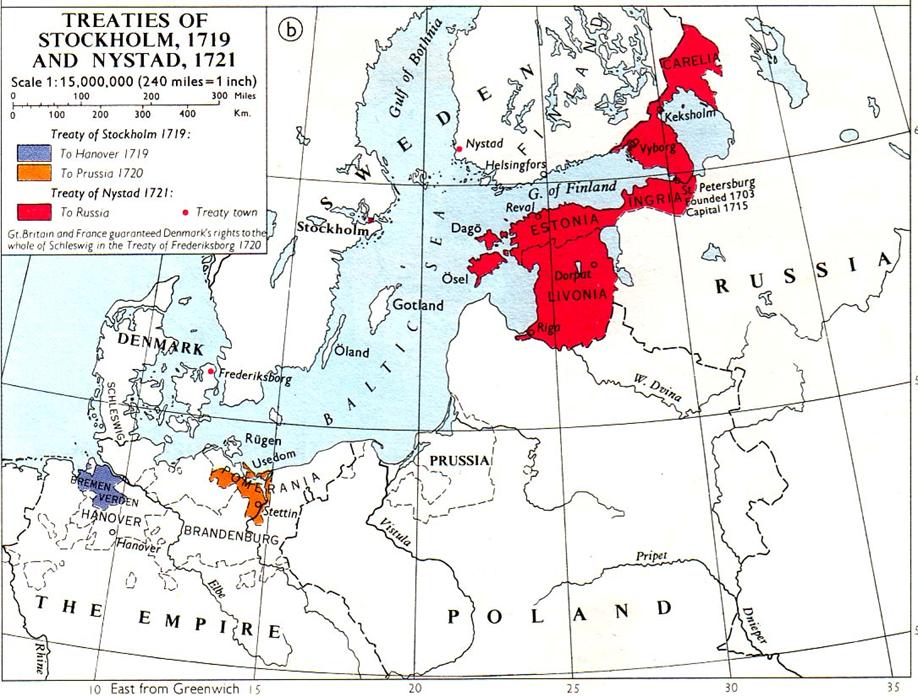
trade through the Baltic coastal cities grew rich selling Russian goods. The Nystad Treaty trade provision gave Russian Orthodoxy entered the Baltic region as a
result of Russian occupation. The German Lutherans and later the Lithuanian
Catholics would later both be marginalized. Russian Orthodoxy was favored in
many ways, including land gains. THE ENLIGHTENMENT CHANGES THE STATUS QUO The Enlightenment spread across Europe beginning in While the northern Baltic region remained stable
after the Great Northern War, Catherine II introduced a new system of taxation. Better
farming technology in west The Enlightenment brought with it new ideas about
questioning the world people found themselves in. This affected religion as
well. The Russian Orthodox Church remained privileged by the Empire, but soon
all of the churches would be challenged by the emergence of atheism. NEW LIBERTIES FOR SERFS As an experiment, Alexander I (Emperor 1801 to
1825), liberated the serfs in some parts of his empire from being tied to the
land and freed them from corvee labor (labor tax).
This occurred in Estland in 1816, in The north Baltics remained
untouched by warfare, but in Polish areas there was unrest. The Polish nobles
had enjoyed great autonomy prior to Russian dominion and resisted Emperor
Nicholas’ I move to greater power with a revolt
in 1830. They were crushed by the Russians and Trade changed as former serfs could now travel to
the cities to get jobs or clear and farm virgin lands. Now that they were
working for themselves, the former serfs had greater incentive to be
industrious and make a profit. This was a profound change from 100 years ago.
Paul I (Emperor 1796–1801) consolidated power in
1800, taking over the functions of taxation and census gathering from the Former serfs who wanted to get ahead financially
sought education. In the north Baltic region this meant learning German.
German patriotism was taught as well because it was a time when German
speakers across
INDUSTRIALIZATION BRINGS MORE Alexander II (Emperor 1855-1881)
is known as the friend of the serfs. Under him in 1861, all remaining serfs
were emancipated including those in eastern The Polish nobles in The Emperors helped remove
economic control from the gilds and nobles by encouraging industrialization,
especially in the north Baltic. A part of this was the introduction of
railroads. The Emperors encouraged the development of prosperity near to People now worked for bosses they
did not know and wondered about religion. This loss of community caused
anomie in people, a loss of belonging to a community. Evangelism brought by
religious sects and nationalism based on language groups emerged to fill the
gap. So it is that trade, religion, and politics are too intertwined to be
subdivided from their effects on each other. In the north Baltic region,
peace allowed social change to evolve uninterrupted. Under Alexander III (Emperor
1881-1894) there was an attempt at Russification in
the Baltic region. The Russian language was taught and administrative reforms
instituted that encouraged the native population to assimilate to things
Russian. But given the choice between Russian and German hegemony, the local
people chose to emphasize their own language and culture. (Raun 66-67) BEGINNING OF THE END By 1900, the Baltic Germans began to see themselves
as Germans unified by language first, and nobles of the Russian Empire
second. With freed serfs moving about, the Emperors and the Baltic Germans
each tried to win them over to their side in the struggle for power. In the
end, the native serfs saw themselves as Estonians and Latvians based on their
own languages and culture.
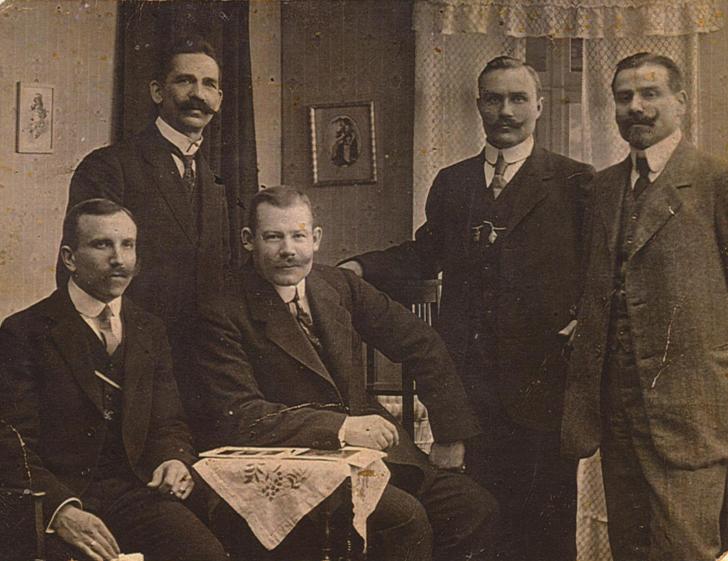
A group of captains
working for commercial fleet, Riga/1914 Industrialization brought great prosperity.
Prosperity brought the regulated work week and free time. This allowed people
to develop culture around theatres, folk festivals, gymnasiums, choirs and
activist groups such as temperance groups. Hereditary political and economic power
via land ownership died in the face of city society. Now with economic
opportunities open to all men by law, the measure of a man was his education
and his wealth, not his heredity. Work organizations now also replaced the
social connection previously provided by religion. Religion was no longer a binding force for society
as it once was. But it still served to divide people. Russian Orthodox
churches were built in the center of every city in the Empire to show its
favored position. When the Emperor opened lands in REVOLUTION AND WAR END THE EMPIRE In 1905 Emperor Nicolas II (1894-1917) faced
socialists calling for social justice and, among other things, regional
administration based on the languages of the masses in To placate the workers, Nicholas II instituted the Duma.
Property owners in the regions of the Empire now had elected representatives
speak for them – but Nicholas retained absolute power. Nevertheless, the
exercise in powerless representative democracy prepared the Baltic people for
the real thing. In 1914 Russia entered
WWI on the side of the Allies. One notable side effect of this war was
the creation of ethnic battalions from the Baltics.
In the case of the Latvian Riflemen, they would turn out to be key players
that help destroy the Old Russian Empire. The Germans defeated the Russians
in 1917 and took land up through The Russian Empire was now dead from war and
revolution. The ex-serfs of the Baltic had gained so much freedom of economic
opportunity only to lose such gains to war. Their political ambitions would
be suffocated under German rule. The Baltic Germans who had long been losing
power to
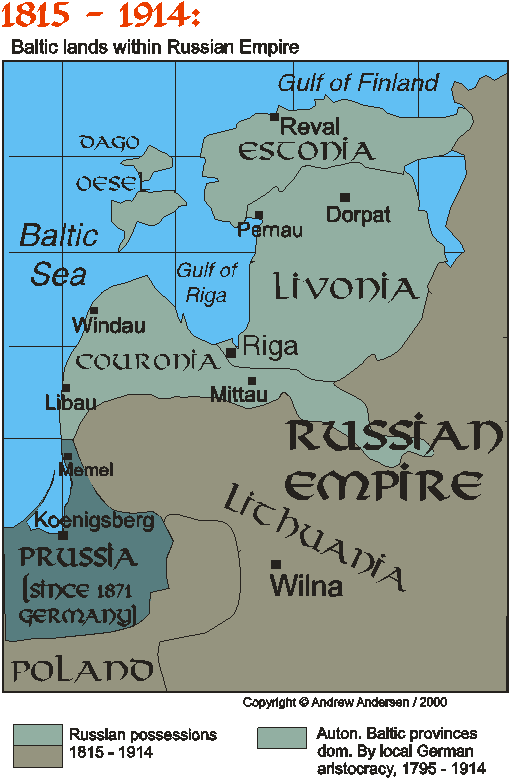
Map of Baltics provided
online by Federation of East European Family History Societies.
<http://feefhs.org/maps/ruse/re-balt.html> This map
shows the areas of Bowlt, John et al, Cambridge
Encyclopedia of Russia and the Soviet Union. This book provides basic sketches
of the lives and reigns of the Russian Emperors. It does not mention very
much specifically about the Baltic. Embassy of Embassy of This website provides lots of
information about Latvian history. Estonian Institute, “Russian communities in by the Estonian
Institute] <http://www.einst.ee/factsheets/russians/#Ivan%20the%20Terrible%20and%20the%2016th> (Accessed 17 April 2002) This website is a fact sheet that
discusses the presence of Russians in Kelley L. Ross, Ph.D,
“Successors of article was submitted to and
presented by the Department of Philosophy, Los Angeles Valley College for
publication in The Proceedings of the Fresian
School].<http://www.friesian.com/russia.htm#sources> (Accessed 17 April 2002) This site gives a very clear and
concise history of the Russians from their Viking beginnings through to the
present, including the Russian Empire. A couple of nice touches include time
lines and maps. It describes the expansion attempts by Ivan IV including his
moves on the Baltic region. It also discusses Peter I establishment of Kirby, David. This is an expansive study of the
history of the peoples of ---. The Baltic World 1772-1993: Age of Change. This is the continuation of the
above work of history. It contains information about how the Russian Emperors
policies affected the lives and balance of power between peasants and nobles
in the Baltics. LeDonne, John P. The Russian Empire
and the World 1700 – 1917. The book is excellent in detailing
the rise and fall of the Russian Empire. The details of political intrigue
are extensive. This book connects the events in other parts of the Empire and
its borders to the policies in the Baltic. There is also great detail about
Swedish politics and how they affected Russian policy. Raun, Toivo U. Estonia and
the Estonians. Stanford: 2001 This book is an expansive
source of history on “Russians in Rusu Kulturos Centras] <http://www.rkc.lt/paveldas/russkie/rusengl.html> (Accessed 17 April 2002) This website touches on the
cultural influences of Russians in Slatter, John. “Russian History Home
Page,” [This web page is published as link <http://www.dur.ac.uk/~dml0www/Russhist.HTML >
(Accessed 1 June 2002) This web page is an abundant
source of primary documents regarding Russian Empire History including The
Emancipation Manifesto, March 3, 1861, the Manifesto of 17 October 1905and
the Abdication of Nikolai (Nicolas) II, March 15, 1917. The web page appears
to be a resource for students of Russian history at the St. Petersburg Times newspaper in <http://www2.sptimes.com/Treasures/TC.2.3b.html> This website is virtual tour of
the “Treasures of the Czars” exhibition by the Originally
published at http://depts.washington.edu/baltic/papers/
|