|

|
The Baltic Region during WWI
By Erin Gettman
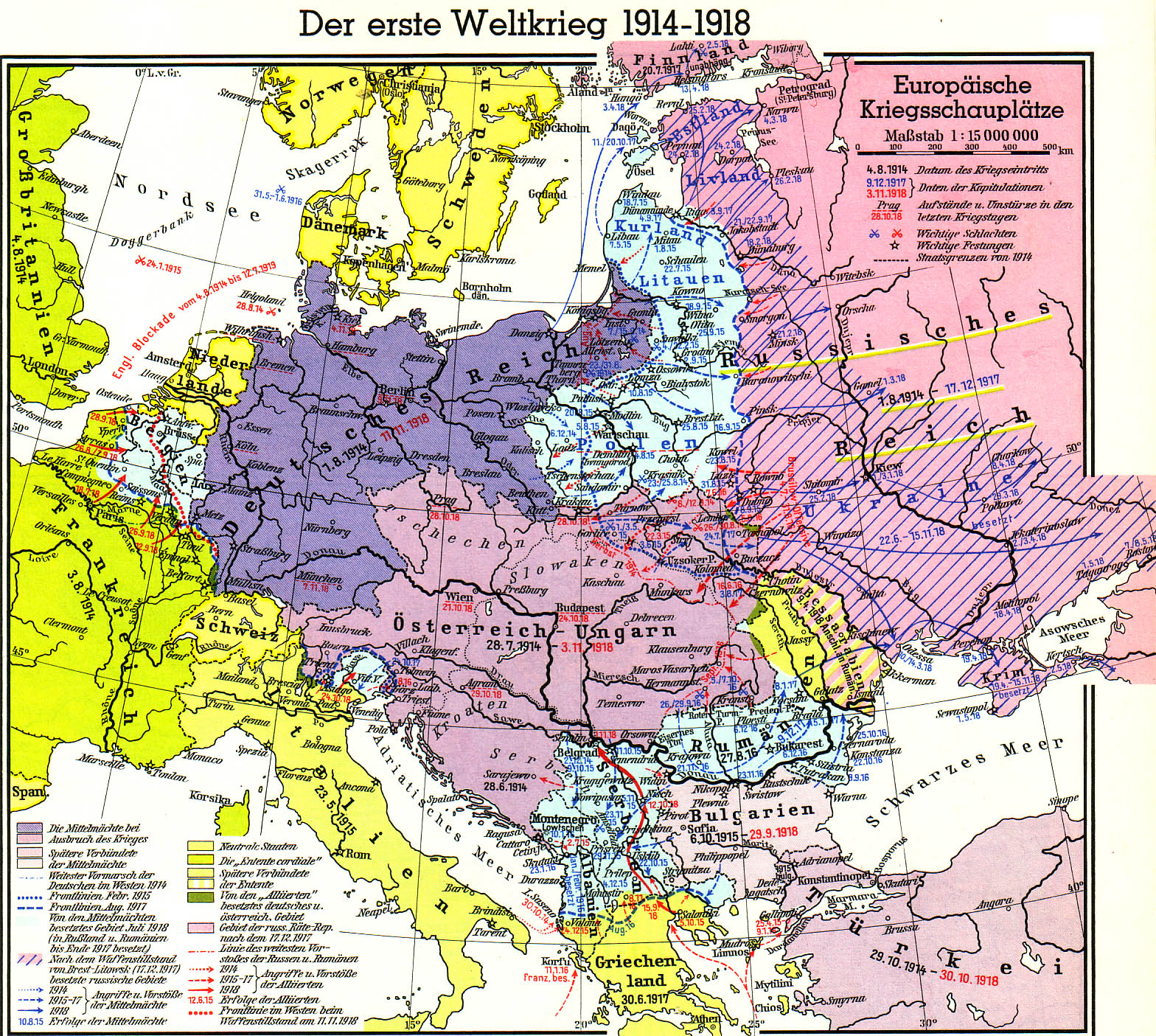
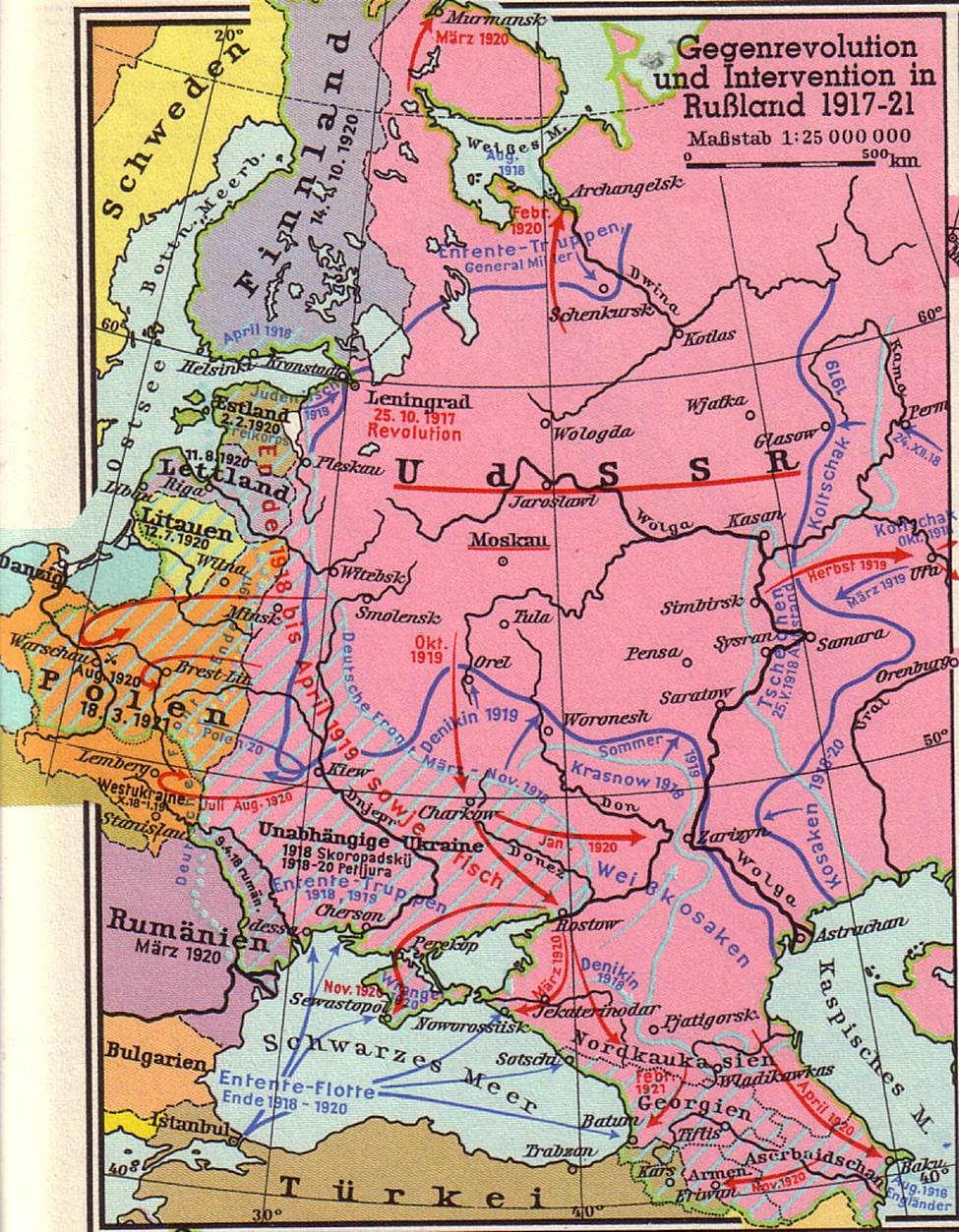
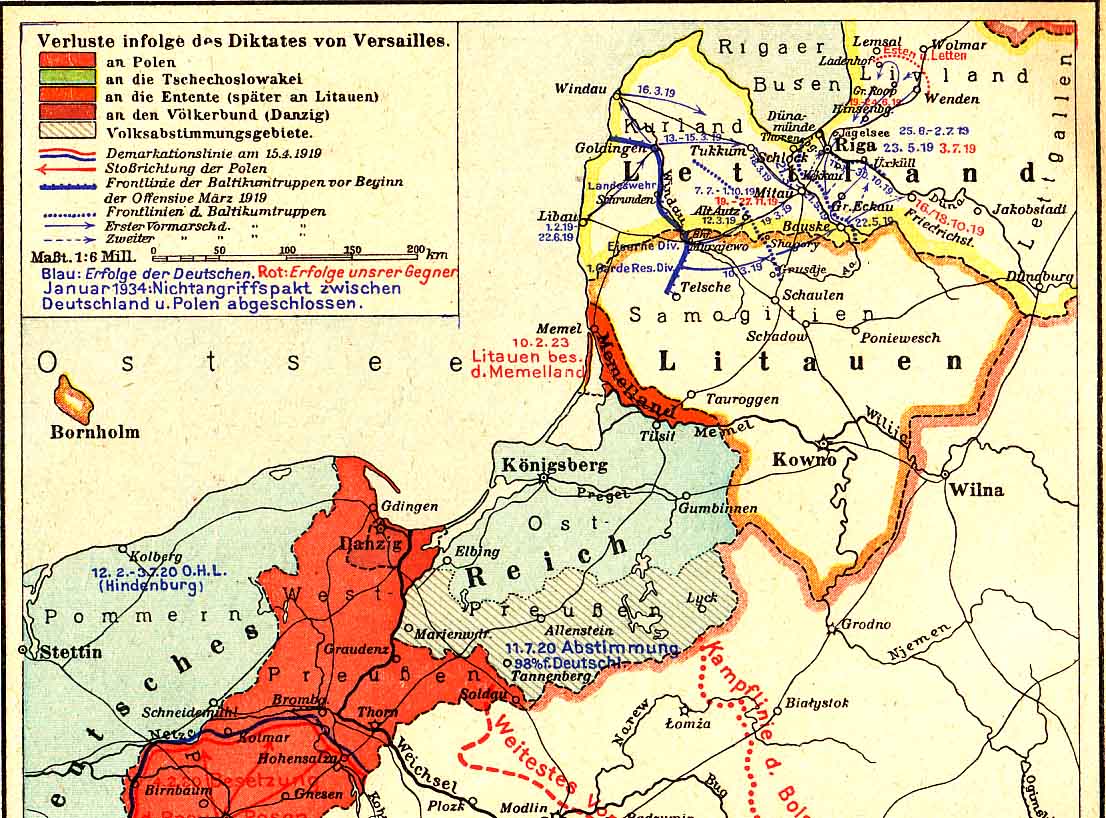
Maps: Westemanns Atlas zur Weltgeschichte,
Berlin, 1953
|
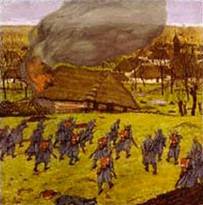
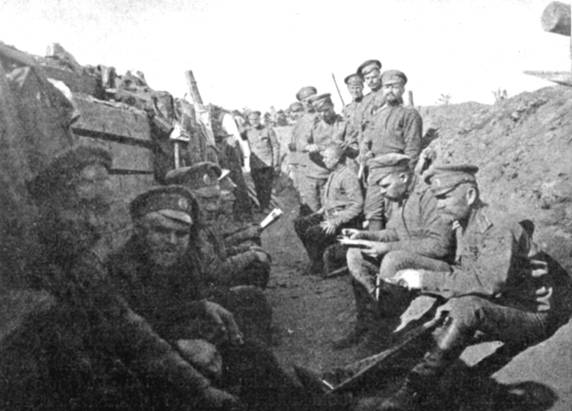
During World War I the experiences of soldiers on the
Western and Eastern fronts were dramatically different. While the West was
dominated by industrial warfare, mud, and trenches, soldiers in the East found
themselves in huge, evacuated territories, far away from anything familiar to
them. Before this conflict, most people outside of Russia new absolutely nothing about
the lands to the North. Through eyewitness accounts of various participants,
directly and indirectly involved in the war, light is shed on Estonia, Latvia,
and Lithuania
from the beginning in 1914 to beyond the Versailles Treaty in 1918. Despite the
area’s unfamiliarity, World War I carried in a certain degree of modernity, as
well as altered and recast political ties in the area today known as the Baltic
Region. By the weakening of the two main imperial powers in the area – Russia and Germany
– small countries such as Estonia,
Latvia, and Lithuania were
able to emerge on the European map.
Click on the map to
see the details

The War at Home
The outbreak of the war in August 1914 was met with mixed
emotions in the Northern Baltic region. In Estonia there was a level of
excitement for a struggle against a historical enemy, but for many Baltic
Germans war against their fellow Germans was inconceivable. The Tsarist
authorities, becoming more and more suspicious of a Baltic German – ‘enemy
German’ alliance, closed down German schools and societies, and prohibited the
public use of the German language. Russian nationalism was not only directed at
Germans, however, but also against all non-Russian nationalities. Constraints
were likewise placed on the use of Estonian.
Throughout the Russian Empire, the war thrust itself into
the lives of millions. The first resistance to German belligerence came about
in the formation of nine regiments of Latvian Riflemen (discussed further
below). About 100,000 Estonian men – close to 10% of the ethnic population –
were conscripted into the Tsarist armed forces. (Raun,
p. 95) Despite the fact that Latvian national troops had been incorporated in
July 1915, no parallel Estonian or Lithuanian divisions were created before the
February Revolution in 1917. There had been a predilection by Estonian
political leaders to establish national units,
nonetheless fear of simply making the situation worse prevented any such
developments at the time.
Although Estonia
managed to avoid war on its own soil until after the February Revolution, the
proximity of the front, which ran for two years along the present day Daugava river in Latvia, led to great changes in the
economy. Industry was now set toward military production, while the
agricultural stratum suffered from the consequential loss of men (about 75% of
those mobilized came from rural areas), as well as the loss of livestock and
machinery. (Raun, p. 95) However, perhaps the most
lasting industrial effect of WWI was the fact that the big factories were
evacuated into Russia
and never returned.
Grassroots Experiences
In the eyes of the common people of Latvia, the old autocracy had returned in
defiance of the Allies and America.
According to the letters of Warwick Greene, a lieutenant colonel in the
American Army sent to negotiate peace in the Baltic, Latvian soldiers were
instructed not to resist, and in his opinion showed “admirable fortitude and
forbearance under intense provocation and almost intolerable circumstances.”
(Greene, p. 93) Because they could do nothing, the native Baltic peoples looked
westward for help from democracies or eastward towards Bolshevism. Greene
correctly predicted that their patience would not last indefinitely, that the
Latvian people would eventually resist the new regime with bloodshed.
Greene’s accounts tell of a Lithuanian Countess and her
family who endured three and a half years of German occupation:
Prussian soldiers clicked about the manor house, German
Soldiers were billeted in the barns. No mail, no newspapers;
we were completely cut off from the world. So far as
we
knew, Germany
had conquered the world. (Greene, p. 138)
Justifiably, the Countess questioned her families, as well
as her country’s future. Her main concern appeared to revolve around what the
Allies would ultimately do with the region. Create an independent Lithuania? Let Germany or Poland take hold? Allow Russia to
reabsorb the country, or would they be abandoned to the Reds?
The Countess described the emergence of an organization
developed for self-protection called the Green Guards. They named themselves as
such in order to be distinguishable from the Reds – the revolutionary troops –
and the Whites – the anti-revolutionary soldiers. The Green Guards were created
for defense of the village; when White or Red guards came into the area the
Green Guards drove the cows into hiding places in the swamps and then hid in
the woods to snipe the enemy when they started to plunder.
The following is the story of Khaim
Kusilovish, of the village
of Pikeli in
modern day Lithuania.
The population of Pikeli was around 150 families. The
overwhelming majority were Jews, but there were also
ethnic Lithuanians and Latvians. Relations before the war were entirely
benevolent, and mobilization took place peacefully. In 1915 the Germans came to
the village. They behaved well towards the inhabitants, and for the most part
paid for their goods. The Germans spent about three weeks in the village and
then one day they were gone. The week after the Germans left, about ten Russian
scouts entered the village and there were slanders against the Jews regarding their
hospitality toward the Germans. On May 2, 1915, an officer announced that
everyone was being expelled, including the seriously ill and aged.
Another eyewitness account is from the village of Kleidany in the district of Kaunas (Lithuania). All
throughout April of 1915 there were Russians who stole from the shops, gathered
all of the goods together and sold them to peasants for next to nothing. There
were incidents of assaults and rapes, but when victims went to the commandment
he did not even bother to answer. (Chayesh)
Latvian Soldiers
As a part of the Russian Empire at the onset of the First
World War, Latvia
was immediately brought into the conflict. In August 1914, the integrated
Latvian soldiers were sent to Eastern Prussia
where they met defeat at the hands of the Germans. In April of the same year,
the German army advanced into Latvian territory. With the looming threat of
losing their homeland, a request was put forth to the General Headquarters of
the Russian army for the establishment of separate Latvian military units in
order to defend themselves. In August 1915 eight
regular and one reserve Latvian Riflemen battalions were created, all named
after Latvian towns, as part of the 12th Russian army. (Latvian War Museum)
Collectively, 8,000 soldiers volunteered to join the battalions. Latvian
officers were allowed to undertake command, and the use of their native
language was even permitted. These units were involved in much of the fighting
of 1916, sustaining exceptionally heavy casualties in the ‘Christmas Battles’
of December 1916 - January 1917, where their death rate reached a dramatic 37%.
(Latvian War Museum)


The Latvian Riflemen set themselves apart from other units
through discipline, fighting capabilities, educational and cultural levels, and
most importantly by their heroism, which arose from a foundation of faith in
freedom and independence of Latvia.

German Occupation: Verkehrspolitik
& Kultur
Military triumphs in 1914 and 1915 brought the German
armies into possession of the territories along the Baltic Coast.
They found themselves in a land of foreigners with unfamiliar traditions,
cultural identities, and histories. Seeing the east for the first time during
the war, amidst the disorder, disease and confusion, they took these sights as
ordinary, constant, characteristics of the newly conquered land, not as
instances of life under the oppression of war. (Liulevicius,
p. 6)
The October Revolution forced the Russian army out of the
war, resulting in the Armistice of December 1917. The ensuing Treaty of
Brest-Litovsk on March 3, 1918 established peace between Germany and Russia, as well as brought about a
new, German dominated stage to WWI. (Raun, p. 104)
The Brest-Litovsk Treaty gave Germany
the freedom to pursue ambitions in regards to Russia’s former possessions in the
East. The German army believed it could reshape these lands and peoples into
one resembling its own image, in turn paving the way for permanent possession.
Their first challenge was the utter extent of the captured spaces, and how to
go about implementing control. The resulting attempt was to build an immense
military state beyond Germany’s
borders named “Ober Ost”
(after the title of the Supreme Commander in the East, Oberbefehlshaber
Ost). (Liulevicius, p. 7)
in the Ober Ost, General
Erich Ludendorff and his officials established a huge structure of
administration in the occupied territories. One specific practice was called Verkehrspolitik, or “movement policy,” by which officials
sought to impose control over not only the population, but to direct all
activity in the area to benefit the military state. It used modern techniques
of surveillance, registration, and documentation to assemble all available
resources, object and human. The administration’s first step was to close off
the territory. The land was then divided up into administrations, which were
further separated into administrative regions, and finally subdivided into
smaller districts.
As natives were not allowed to move between the official
boundaries, this created obvious hardships. The borders were often established
without any consideration given to existing patterns of settlement of social
organization. Natives could not travel to visit relatives or friends, and
traveling Jewish merchants lost their livelihood entirely. Military courts
inflicted huge fines, penalties and even confiscation for violations.
There was also a cultural counterpart to the ‘movement
policy.’ While Verkehrespolitik controlled the land,
borders, and movement, Ober Ost’s
command aimed, through a process called Kultur, to
transform the identities of the different native populations, essentially
trying to impose a new culture where ‘uncivilized’ peoples would be ameliorated
by German ‘genius.’ Considering the area’s ethnic diversity, this was a rather
large objective, which involved, more or less, reinventing their culture. Ober Ost’s cultural policies had
three aims. First, they wanted to put forth an impressive image of the state
and it’s civilizing effect in the East. Second, native
culture was to be infused with German institutions, which would redefine their
identity and guide their development. Finally, they also aimed to provide
German soldiers with a sense of their mission.
Regardless of these objectives, arrogant, overreaching
ambitions brought constant conflict between the seemingly utopian ends and
barbarous practices of the state’s policies. Instead of successfully molding
the native peoples to German ideals, what resulted was an outburst of native
resistance. Throughout the implementation of German Kultur,
the native Baltic peoples had come to recognize and embrace the individual
characteristics of their own cultures. A feeling of nationalism sprung from
these realizations and a renewed sense of vigor spread throughout the region.
War Beyond November 11, 1918
Collapse of the ‘German Order’ in 1918, after an almost
assured victory in the east, was beyond comprehension for the soldiers of Ober Ost. Humiliation,
frustration, and regret caused a feeling of fury, which was then aimed at the East
and its inhabitants. The resulting group of German Freikorps
unleashed their hatred as well as their refusal to accept defeat on the Baltic
lands after the war. Contrary to popular belief, World War I did not end
precisely in November 11, 1918, but continued through acts of violence let
loose from a group of people who refused to accept defeat.

In June of 1919, in an effort to secure its southern
border, Estonian national forces were compelled to defend themselves against
two groups; the Landeswehr,
a Baltic German military force, and the Iron Division, which was made up of
Baltic and Reich Germans led by General Rudiger von der Goltz. (Raun,
p. 109) In the Landeswehr War, as it was refered to, and under the guise of fighting Bolshevism, Von
der Goltz attempted to
takeover the Baltic, but was nevertheless defeated in a short, yet bloody
battle, by the Estonians.
Click on the map to
see the details

The ambiguity of power left behind by Ober
Ost created an opportunity for many competing
political groups in the area. With the defeat of Germany, natives from the three
Baltic countries rushed to establish republics. These ambitions soon faced a
new threat from the East when the Red Army invaded. The Bolshevik’s leader was
actually a Latvian and former head of the 5th Latvian Rifles
Regiment. Despite the fact that they were lacking in organization and
equipment, the Reds experienced little opposition from the exhausted natives.
The Latvian population, in fact, provided the newly declared Soviet government
with the most support of any of the Baltic countries. This was mainly due to
sympathies held for their fellow countrymen in the Latvian Rifles Regiments,
the Red Army’s most trusted division. Nevertheless, the violent atrocities that
ensued over the coming months depleted Latvian patience and cooperation.
In Lithuania
the Bolsheviks found even less support than in either Latvia or Estonia. In rural areas, farmers
organized local assemblies supporting their resistant government, and
eventually – after an incentive of land reform – the formation of an army
began. Even so, by late February, Latvia
and most of Lithuania
were under communist control.
The tables began to turn in Estonia, where officers coordinated
an army out of sections of disbanded Estonian regiments. The Allies, concerned
about Soviet expansion (though not willing to offer troops), provided them with
weapons and supplies, while 1,000 Finnish volunteers provided reinforcement. On
February 24, 1919, Estonia
defeated the Reds and claimed its independence.
Almost a year later, on December 13, 1919, Lithuanians
pushed the last of the Freikorps into Prussia.
As was common with most of the invading troops of World War I, the Freikorps saw the East as a place with no limits. Unaware
of the existing plethora of culture, German and Russian soldiers attempted to
overrun the native Baltic population and force upon them an entirely new, and
in their view, civilized way of life. Although these ambitions were never
completely met, the events of World War I radically altered the world’s
perception of Northeast Europe, and put Estonia,
Latvia, and Lithuania on
the map.

BIBLIOGRAPHY;
Chayesh, Anatolii, LitvakSIG, Chicago, IL, [On the
Front Line in Lithuania,
1915], 2002.
http://www.jewishgen.org/litvak/1915fline.htm
(May 28, 2002)
This site contains 25 eyewitness accounts of German and
Russian occupation in various Lithuanian villages during WWI. They describe
their treatment by their occupiers as well as their feelings towards them.
Department of History Map Library,
[Maps of the World War I], n.d.
http://www.dean.usma.edu/history/dhistorymaps/WW1Pages/WW1ToC.htm
(May 20, 2002)
Provides 52 maps of various stages
of the war, from the western front to the eastern front. Begins with the eve of the war in
1914 and ends with the political realignments in 1919. Map #40 shows Hutier’s offensive in September 1917, a battle in Riga where the Russian
troops surrendered to the Germans.
Greene, Warwick. Letters of Warwick Greene, 1915-1928. Boston: Houghton
Mifflin, 1931.
This primary document is a compilation of the letters of Warwick Greene, Director
of the Rockefeller War Relief Organization. It gives incite into his thoughts
as well as a running account of the war. Sections are dedicated to Greene’s
mission to the Baltic States to negotiate
peace, investigate and report on military, economic and political conditions
during the war.
Latvian War Museum, Riga, Latvia,
[Latvian Soldiers in the First World War 1914-1918], n.d.
http://www.karamuzejs.lv/en/ekspozicijas/1kars_e.htm
(May 28, 2002)
This site provides information on Latvia from the First World War up
until the end of Soviet occupation in 1990. Eight sections emphasize Latvian
soldiers during various wars, including WWI, the Russian Civil War, and WWII.
Kirby, David. The Baltic World 1772-1993. New York, Longman
Publishing, 1995.
In Kirby’s second volume of the History of the Baltic, he
disputes the idea that the many reforms, revolutions, and rebellions of the
time were brought about by actions by the outer rim of society. Kirby argues
that Northern Europe was actually very
flexible to change. Beginning in 1772, Kirby breaks his information into two
sections, The Age of Empire, ending with WWI. Section Two, Nations and States,
begins with the New Order and ends with the fall of the Soviet
Union and its effects of the people of the Baltic.
Liulevicius, Vejas. War Land on the Eastern Front. Cambridge; The Press
Syndicate of the University of Cambridge,
2000.
This book tells of the German army’s experience on the
Eastern front, and explains how radically different it was from the Western
front. It also describes how the primitiveness of the East led to the “demondernization” of the Eastern front, as technology was
not as important there as it was in the West. There are also a number of
wonderful maps depicting the changing borders and front lines of Eastern Europe.
Mawdsley, Evan. The
Russian Revolution and the Baltic Fleet. London; The
Macmillan Press Ltd., 1978.
Mawdsley argues that
the slight attention that has been paid to the Baltic region has had too much
focus on the leadership of government and political parties, and not enough on
the ‘grass-roots’ of the area. While he does examine the developments at the center, Mawdsley also looks at provincial areas. The book continues
past the end of the war into April 1918, discussing what he calls the real end
of the ‘pre-soviet’ Baltic Fleet.
Tschischwitz. The Army and Navy During the Conquest of the Baltic Islands
October 1917. Fort
Leavenworth; The Command and General Staff School
Press, 1931.
This primary document written by
then Chief of Staff of the German Expeditionary Corps, Lieutenant General Von Tschiswitz. He goes further than just retelling his experiences
and also analyzes his enemy –The Baltic Fleet’s- strategies and defenses. He
compiles them into 24 descriptive chapters along with 16 sketches of the Baltic
area in different stages of the war.
Originally
published at http://depts.washington.edu/baltic/papers/
BACK TO
THE BALTIC STATES