|
|
Baltija and the Vikings
By Joshua
Leggett
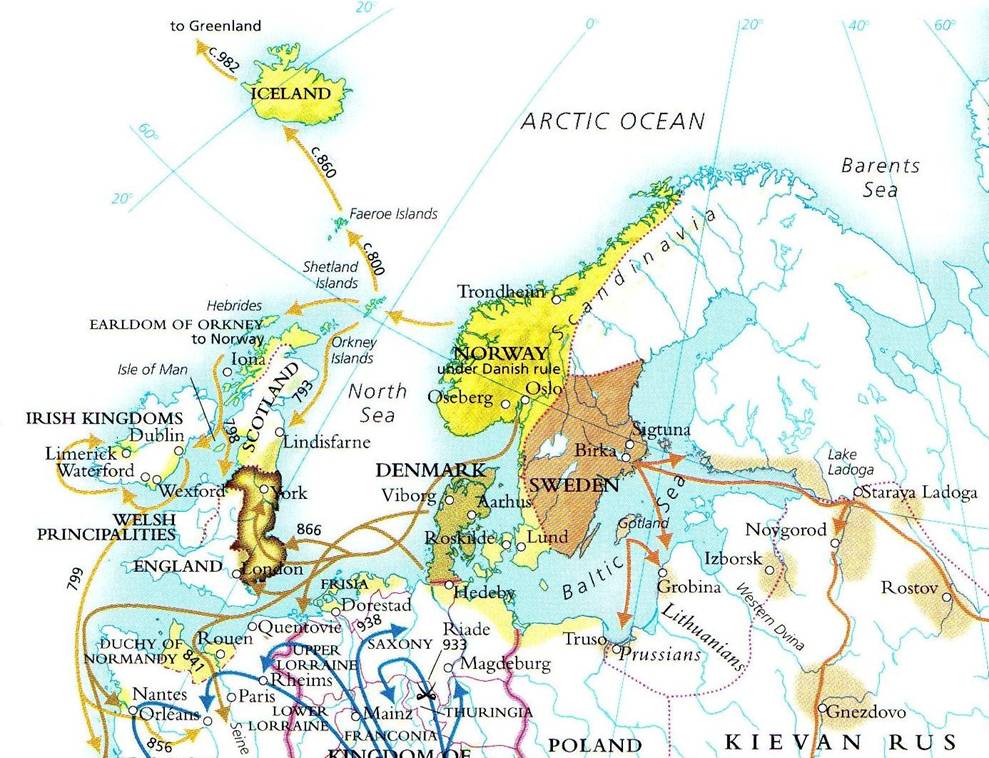
Map: Black,J., Atlas of World History, London, 2000
|
The
Viking Age can be said to have started with the attack of Lindisfarne,
June 8th, 793 AD and ending September 25, 1066 at the battle of Stamford Bridge where the King of England
defeated the King of Norway. Between these dates (happening to both be in England)
Vikings explored, conquered, traded, pillaged, plundered and journey all over
the known world and beyond. Viking activity towards the East, Russia, the Arab Caliphates, Byzantium and the Baltic Region is an area
far less written about and understood about than continental and insular
Viking activity. Even less is known about the Vikings in today's Baltic
states of Estonia, Latvia and Lithuania.
The
Baltic Sea separating Sweden
and Finland
from the Baltics states was a highway of trade and
still is for the many nations and peoples who live on its shores. Primarily
when Vikings, namely Swedish Vikings, went to the Baltic region they simply
wanted to pass through this area as quickly as possible. Their goal was to
the prosperous regions of Russia
and east and southwards. Primary sources and Sagas of Viking activity are
few, such as 'Egil's Saga' which has episodes of he
and his brother being caught by Kuronians, as well
as 'The Chronicle of Henry of Livonia', written after the Viking Period,
which too mentions Vikings a scant number of times in the East Baltic lands.
The
Viking 'nations', Denmark,
Sweden, Norway and Iceland journeyed around the
world on their expeditions primarily as their local geography allowed them. Norway in the West sent forth Vikings to England, the North Atlantic
Islands and in turn
Continental Europe. Denmark
being physically attached to mainland Europe
had connections primarily to its south but also to some extent east and west
of its peninsula. Sweden
facing eastward is the main contender with the eastern Baltic coast. Sweden was the primary source of Viking
activity from present day St. Petersburg to
the Arab Caliphates and Byzantium.
It was by way of the extensive river systems through Baltija
(the region containing present day Estonia,
Latvia and Lithuania) and Russia that these Swedish Vikings
would travel back and forth.
- Brief Pre-history of the
Vikings and Baltic Peoples
From
the end of the Ice Age 10000 years ago people have populated the northern
lands of Scandinavia (consisting of Norway,
Denmark, Sweden and Finland) and Baltija
(Plakans, p 1). Arrow heads and bone fishhooks are
among the scant evidence we have for this (Raun, p
7). By 4000 BC farming was practiced in the southern regions of Scandinavia,
followed by the Bronze Age around 2000 BC improved by iron-working abilities
by 500 BC (Haywood, p 24). As far as Baltija was
concerned there were two main people groups that moved into the region
following the receding of the Ice Age glaciers. Around 3500 BC came
Finno-Ugric tribes. They are identified by their 'trademark' "Comb
Ceramics". Nearly 1500 years later, came proto-Baltic tribes, an
Indo-European group. The evidence for this is a new kind of pottery appearing
called "Rope Ceramics". It is with these tribes that agriculture
was introduced to the region. A reason that this is thought to be true is the
number of loan words in the Finno-Ugric languages today in reference to
agriculture and animals associated with farming from the Baltic languages.
Stone "Boat Axes" also were introduced to the area at this time,
about 2000 BC (Spekke, plate I, II).
Little
else can be said as to the customs and cultures of these peoples both in Scandinavia and Baltija in
the pre-Roman and even Roman times. How these tribes lived, whom they traded
with and whom they warred with is hard to say, if not impossible to say. It
is possible that these three groups of peoples (proto-Scandinavians, proto-Balts and Finno-Ugric tribes) had contact with one
another. This is most easily shown in the case of the Balts
and Finno-Ugrics, but as for cross Baltic Sea contact little if anything is known.
Not
until the first century AD do we hear of the Baltic peoples, by way of a
Roman the Aesti are described. The Roman historian Tacitus
is the first possible mention of these Baltic tribes in Baltija.
He describes from second hand accounts the northern German tribes with whom
the Romans were beginning to encounter on a more regular basis. He then
describes the "Aesti" as follows: " whose rites and fashions… are those of the Suevi… They worship the mother of gods…they are more
patient in cultivating corn… than… the Germans…they gather amber…"
(Tacitus, p 731).
B. Archeological Evidence, The Sagas and Primary Sources
- Archeological evidence
Runic inscriptions that are found are one of
the best pieces of evidence one can have for Viking presence in an area. One
such piece of an ornamented limestone disk with runic inscription has been
found in Latvia,
dating to the 11th century (Spekke,
plate X). However the most conclusive evidence of Swedish activity in Baltija, especially the Latvian territories are the
numerous Runic Stones erected in Sweden in memory of Swedish
Vikings who died abroad. A number of Viking boat graves have been located in Baltija along with some silver hoards. These
unfortunately on reveal to us that Viking were there, but what they were
doing is still unknown.
- Sagas: Heimskringla
(Olaf's Saga), Egil's Saga
Two Icelandic Sagas', both attributed to the
12th Century author, Snorri Sturluson has tales of Norwegian Heroes in Kurland and Estonia.
The Heimskringla is a collection of the
saga's of the Kings of Norway from the foundations of the World and the
beginning of the Nordic race ending with Sverre's
Saga, whose reign in Norway ended in 1177 AD (Heimskringla,
p xxiii). It is from the Saga of King Olaf Trygvesson
out the Heimskringla that this passage comes
from:
"Hakon the Old
gave her [Astrid] good attendants, and what was needful for the journey, and
she set out with some merchants. …Olaf was three years of age. As they sailed
out into the Baltic [Sea] they were captured by Vikings of Esthonia, who made booty both of the people and goods,
killing some, and dividing others as slaves… Reas
[an Esthonian] bought Olaf for a good cloak… Olaf
was long with them, was treated well, and was much beloved by the people.
Olaf was six years in Esthonia in this banishment
(p 8,9)."
This is from Chapter V of Olaf Trygvesson's Saga, the next two conclude this
story of Olaf's time in Estonia
and Russia
with his release from slavery and his murdering of Klerkon,
the man who first enslaved Olaf.
In Egil's
Saga chapter XLVI is entitled "Thorolf and
Egil Harry in Kurland".
This story is basically as follows:
Thorolf, Egil
and their company of men are plundering a seemingly abandoned farmstead and
while leaving they are unwittingly led into a trap set by the Kurlanders. Egil and his
company are tied up and locked into a building on the farmstead and put there
overnight. Egil "set to work and made trial of
the post till he gat it
loosened up out of the floor…and now he loosed his fellows (p 88)." The
Norwegians then re-ransack the farmstead and head towards their ships. Egil on his way back to the boats stops and says,
"This journey is altogether ill, and nought
man-of-war-like. We have stole the bonder's fee, so
as he knoweth nought…
Never shall we take on us that shame. Fare we back now and let them know what is come about (p 89)." And back Egil goes to tell the unfortunate Kurlanders
that he had escaped and looted them and is his letting them know who did this
to him he throws fire onto the roof and kills any men at the door and
without. Satisfied with his now honorable deeds of plundering he and his men
sail to Denmark.
Snorri Sturluson
and his writings epitomized the art of Saga writing. However, since the most
prominent writers of this time (12th and 13th
centuries) were from Iceland
and Norway
most attention was focused on these Kings and Heroes. With Western Nordic
writers chronicling these adventures, Viking activity in the East was
mentioned only briefly, but nonetheless colorfully.
- Primary Sources
The
Emperor Porphyrogenitus in his chronicle On the
Administration of the Empire (c. 954 AD) describes the route which the
Viking took from the Baltic to Constantinople
(Roesdahl, p 290). Other Chroniclers wrote of
Scandinavian encounters in Baltija; Saxo Grammaticus, a Danish historian wrote of raids and
wars between Balts (esp. Kurlanders)
and Scandinavia. As we as Rimbert's Vita Anskarii
also mentions contact between the two cultures (Spekke,
p 80). There are few contemporary sources describing actual events between
Vikings and Baltic people. The chronicles of Saxo
and the Chronicle of Henry of Livonia were written just after the
"Viking Age". Most of the references to contacts in these
chronicles are not recorded anywhere else and therefore have to be carefully
considered in their value as to what actually occurred.
- Raiding, Pillaging,
Settlement and…
Unfortunately, few Northern European people
groups had developed systems of writing to record their histories and
contacts with other cultures around them. From the previously mentioned
Tacitus we get our first encounter with the Balts.
Scandinavian pirates soon began to repeatedly invade the shores of Baltija where sometimes large battles were fought and at
times resulted in the imposition of tributes being paid to the pirates (Spekke, p 73). With their relatively light and strong
Viking boats soon Swedes and some others were passing through the Baltic
region regularly by the 9th century. These new incursions in the
area around the 9th century marked the beginning of the Viking age
in the East. Viking activity in the east was primarily concentrated in Russia
and her river systems that lead to the Arab Caliphates who were rich with
silver and gold. No permanent settlements by Vikings were attempted to be
made until a few centuries later in the Baltics.
However, the Swedes and Danes both sent major armies to Kurzeme
(Western Latvia) in particular to battle the
Kurs and keep them under control. Why were the Kurs and other Baltic people being attacked? They were
not only being attacked but also they themselves were attacking Swedish towns
with apparent success. A reason for attacking the region of Baltija was not to conquer the entire region but to
control the river mouths and usable ports. It was by river that traders could
relatively easily penetrate the continent.
- Trade and Settlement with
Baltic and Viking peoples in the Baltic and Beyond
Baltija and its geography also was a
significant reason believed to be why Vikings did not colonized there as much
as was seen in Normandy and England. Estonia's countryside has many
swamps and marshes and offers no natural resources (Raun,
p 5) (iron, gold, silver etc.) except oil shale which would not be able to be
mined for a number of centuries. The Latvian territories had more arable land
and the Lithuania
territories were covered in forests. These areas as well had no significant
metal resources but were able to supply timber to those who were there or
just passing through. Baltija was not without
bronze and iron, by ways of trade and possibly raiding the Balts had many bronze brooches, bracelets, weapons and
other jewelry (Spekke,
Ch. 2).
However amber was is large supply on the Baltic coasts. Viking traders to Russia
and further east traded amber, arrows, wax, honey, walrus tusks (from the
Finns) and falcons to name a few (Sawyer, p 114). Baltija
was also a good source for obtaining slaves for trade as well.
There is not much evidence for Viking
settlements in Baltija, it was not until the first half of the 11th
century that Swedes began to establish trading settlements along the coasts
of Baltija (Kendrick, p 187-8). The Vikings chose
to settle at Staraya Ladoga (known to the Vikings
as Aldeigjuborg) as early as the 9th
century (Sawyer, p 114). Settlements were made at Novgorod
and Kiev which were stop off points for the
journeys into Byzantium
and the Arab Caliphates. Hoards of Arabian silver coins were brought to Scandinavia and the Baltic by way of these trade routes
through the Baltic and Russian river systems. Just because thousands of
silver coins and various eastern artifacts have been found in Baltija and Scandinavia
is not conclusive of trade relations between the Vikings and Easterners.
However since the evidence we do have of Viking activity from the Baltic to Byzantium suggests that
only relatively small numbers of Vikings went to and through these regions.
Compared to Viking activity in the West where Normandy, England and the North
Atlantic was overrun by Viking emigration and colonization suggests that the
East looking Swedish Vikings preferred to trade with the peoples of Russia
rather than colonize and push them out.
- The end of the Age
The end of "Vikings" as we know them, who was left in the
Baltic and who was the ruling power around 1000-1100
AD.
By
the end of the Viking Age elsewhere in Europe Viking activity continued to a
lesser degree in the 11th and 12th centuries in Baltija. Swedish Vikings had tried numerous times to
control the Kurs and Semigallians
(both Latvian tribes) but could not maintain a permanent foothold over these
peoples. Certainly expansion into Russia and the Baltic by Swedes
was desired but clearly unrealistic. Trades routes and contacts were
maintained but this over land route to Byzantium
and the East became less and less important as other routes and sources were
exploited and Arabian silver supplies dried up. The local tribes of Latvians,
Lithuanians, Livonians and Estonians managed to
maintain their independence for a while longer, but no without challenges and
eventual conquest by German Teutonic Knights and the continuous Swedish
presence. The Livonians would soon create the
Livonian Confederation and more distinct boundaries and cultural divisions
can be seen and identified. This region of the Baltic is diverse in identity
and in history. Much has happened but little is known. The Vikings had a
profound impact on the Baltic forcing change and sometimes unification of
tribes.
Bibliography
Haywood,
John. The Penguin Historical Atlas of the Vikings. New York: Penguin Books, 1995.
A
good book for a brief but well written overview of Viking history with many
pictures and maps. This source is great if you want to look something up
quickly, as it is well written and easy to use. Pages 100 through 107 deal with Viking activity east of Scandinavia
and their interests in these areas. The rest of the book is topically broken
up dealing with numerous topics from "Women in Scandinavia" to
"The Struggle for England".
Kendrick,
T. D., M.A.. A History of the Vikings. New York: Charles
Scribner's Sons, 1930. 179-192.
Chapter
six is entitled "The South and East Baltic
Coasts". Kendrick
first writes of Scandinavian involvement with the Wends and Jomsvikings then to the East Baltic states speaking of
Swedish ambitions in this region being primarily to pass through the region
as quickly as possible to get to Russia and further East to the
Arab Caliphates. He too mentions Swedish attempts to conquer and settle parts
of Estonia and Kurland and the fact that they were unable to maintain
permanent settlements there during the Viking Age.
Plakans, Andrejs. The
Latvians: A Short History. Stanford: Hoover Institution Press, 1995.
Raun, Toivo U..
Estonia
and the Estonians. Stanford: Hoover
International Press, 1991.
Estonian
History from pre-history times to end of Soviet period.
Roesdahl, Else. The Vikings. Trans. Susan M. Margeson and Kristen Williams. New York:
Penguin
Books, 1991. 277-292.
Overall
the book is a well written history of the Vikings also topically divided up
rather than chronologically. The chapter entitled "The Baltic Region, Russia, Byzantium
and the Caliphate" primarily focuses on Viking interests in trade with
these regions. Mentions of skirmishes and voyages of exploration in the
Baltic area as noted by a few primary sources such as Vita Anskarri and Orosius' History
of the World.
Sawyer,
Peter H.. Kings and Vikings: Scandinavia and Europe AD 700-1100. New York: Methuen and Co. Ltd., 1982.
113-130.
His
chapter "The Baltic and Beyond" focuses primarily on the fact that
the Scandinavians venturing across the Baltic wanted to simply get through
the area into Russia
and beyond. This book is very dense in information and towards the end of
this chapter coin hoards are systematically analyzed as evidence for
Scandinavian activity in the Caliphates and Russia and the journeys back and
forth from the Viking homeland.
Saks,
Edgar V.. The Estonian Vikings. London: Boreas
Publishing House, 1981.
This
book is one of kind being one of few if not the only book focusing on local
peoples of the Baltic and their own Viking activities and encounters with
Scandinavians and Slavs. The book seems to be somewhat biased towards the
Baltic peoples, mainly the Estonians but contains much discourse on primary
sources and accounts.
Schwabe, Arveds, Dr.. The Story of Latvia and Her Neighbours. Edinburgh:
The Scottish League for European Freedom, (?). 6,9.
.
This
very short book (almost a pamphlet) is a brief overview of Latvian History
and her relations to the nations surrounding Latvia. Written during the Soviet
Period sometime for audiences outside the Soviet Union.
The two pages noted above are brief but interesting accounts of Latvia's
encounters with Vikings. In particular how Viking influences and encounters
taught them how (or rather forced them to learn how) to defend them selves from the Russians in the East. –not used in
the paper but still an interesting document to read-
Spekke, Arnolds. History of Latvia: An Outline. Stockholm: M. Goppers-Zelta Abele-The Golden Appletree,
1951. 76-99.
In
Spekke's general history of Latvia he writes a chapter called
"The Vikings and The Latvians". He writes of military and economic
encounters between the two peoples and mentions that the majority of the
information in primary sources is indeed quite vague as to what the Viking exactly
were doing the Baltic region. Most information is from archeological finds
which can be connected to primary source references to the region. He writes
that in the 9th century this was the initial onslaught of Viking
incursions which were more or less ineffectual and at times resulted in
counter attacks by Kurs on Sweden. He too uses a number of
different Viking Sagas which have episodes in the Baltics.
As for the rest of the book it is a useful reference tool for Latvian history
until the beginnings of the Soviet Period.
Tacitus.
"Germany
and Its Tribes." The Complete Works of Tacitus. Trans. Alfred
John Church and William Jackson Brodibb, ed. Moses Hadas. New York:
The Modern Library, 1942.
*
* * * *
[Sturluson, Snorri.] Egil's Saga. Trans. E.R. Eddison. New York: Greenwood Press
Publishers, 1968.
Sturluson, Snorri. Heimskringla, "Olaf Trygevasson's
Saga". Trans. Lee M. Hollander. Austin: U
Texas P,
1964.
Both
Sagas' have a few episodes in which the main characters are in Kurland or Estonia.
Websites
http://haldjas.folklore.ee/BIF/
Baltic
Institute of Folklore web page. Basic links to historical and folkloric
information on Baltic countries.
http://rvik.ismennt.is/~harpa/forn/english/e_egils/e_egils.htm
Web
page(s) with summary of Egil's Saga and basic
summaries about the characters, places and events of the Saga.
http://www.luth.se/luth/present/sweden/history/viking_age/viking_age4/html
Web
page from Swedish university in Lulea.
This page briefly describes the Swedish Vikings in the East mentioning
contacts with peoples in the Baltic region but primarily focusing on Viking
interests to Constantinople and even beyond.
http://www.balticnet.de/FrameE.html
A
German web page still in development but still very usable. This page offers
quick links referring to history/Hansa/Vikings in
the Baltic region. The links are few but have relatively good information
http://viking.no/e/ehome.htm
English
home page for good information regarding general Viking history. Multiple
links to other pages and sites. A site that is easy to read and understand.
http://viking.no/info-sheets/estonia/estonia.htm
A
page contained in the previous website. This page talk
specifically about Viking activity in Estonia. It has three other links
to pages about Vikings in Estonia
and east into Russia.
These pages are relatively new and a brief but unique on the web as they are
the only pages that deal specifically with the Vikings in the Baltic Region.
Originally
published at http://depts.washington.edu/baltic/papers/
BACK TO THE BALTIC STATES
|