|
|
The Hanseatic League in the Eastern Baltic
By Jennifer Mills
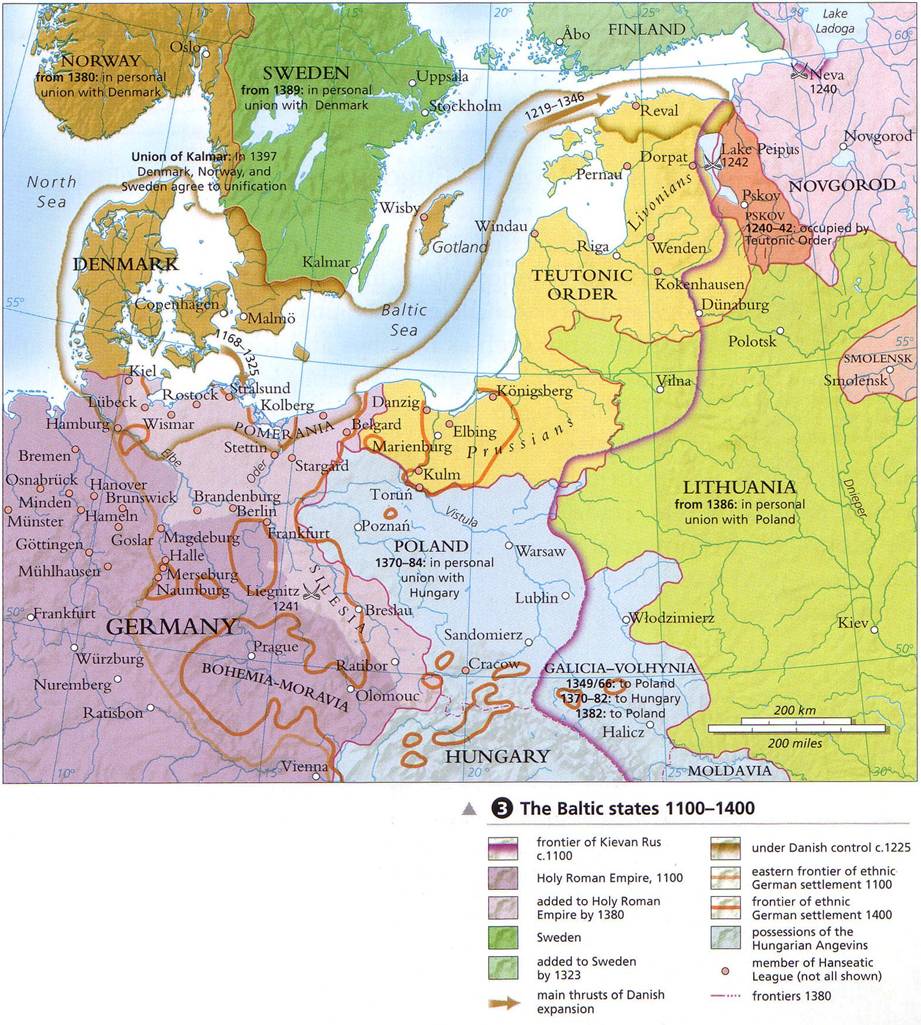
Map: Andras Bereznay
|
The Hanseatic League
(Hansa) was formed around the middle of the 12th
century by German and Scandinavian seafaring merchants. Since there were no
navies to protect their cargoes, no international bodies to regulate tariffs
and trade, and few ports had regulatory authorities to manage their use, the
merchants banded together to establish tariff agreements, provide for common
defense and to make sure ports were safely maintained.
The
original network linked Lübeck, Westfalia,
Saxony and Gotland, but it quickly spread east with the conquest of Livonia in the early 13th
century. The league became so profitable and so powerful that it lasted over
three centuries. At its peak, the Hanseatic League covered the entire North
Sea and Baltic Sea Regions and it stretched hundreds of miles inland along
rivers from the Rhine to the Daugava.
Though
Hansa relations were primarily economic in nature,
the League became a formidable political and military power in the 14th
Century. The Baltic Region that is known today as Estonia,
Latvia and Lithuania
became a viable economic unit in the world market and participant in European
politics via the relationships fostered by the Hansa.
The Rise of the Hanseatic
League
The
Hanseatic League followed the Livonian
conquest into the eastern Baltic in search of Russian goods, agricultural
products and raw materials for shipbuilding. The Daugava
(Düna), Dnepr and Volga rivers were important trade
routes into Russia and
connecting Europe to Asia as early as the
eighth and ninth centuries. For this reason, the first and most important of
the eastern Baltic trading cities, Riga,
was established in 1201 at the mouth of the Daugava.
German
Hansa merchants quickly established trade routes
into the interior of Livonia
and along the Baltic coast. To the north, the Danish crown claimed Tallinn (Reval), which was to
become the second most important Hansa town in Livonia, in 1219. The
town of Tartu (Dorpat)
was situated on the Russian border along the route to Pskov. It played an important role as entry
point for the majority of the Russian goods from the north bound for Riga. Viljandi (Fellin) became the
largest city along the land routes from Riga
to Tallinn, Tartu and Narva. Pärnu (Pernau) was a port city
at the mouth of the river of the same name, but as the second city on the Gulf of Riga, played a lesser role in trade
than any of the aforementioned cities. Narva would
become the sixth of the major Hansa trading towns
in Livonia, but because of its proximity to Novgorod, it remained
relatively unimportant until the 16th Century.
Novgorod was the largest Russian town on the Gulf of
Finland, beyond the ports of Narva and Tallinn. It never fully
joined the Hanseatic League, but in 1259, the League established a Kontor, a trading post, which enjoyed most of the
Baltic trade for Russian goods for at least a century and eliminated the need
for ships to sail the dangerous northern route around Scandinavia.
The Merchant Hansa
Throughout
the 13th century, the Hanseatic League
remained an organization of merchants. To be more exact, it was an
organization of German merchants. Merchants who were not German and did not
belong to the Hansa (so-called non-Germans were
forbidden from joining the League) faced severe trade restrictions in the
Baltic. The Livonian towns refused to permit direct trading between foreign
merchants within their walls. This irritated the Wendish
members of the League, who were thereby prevented from negotiating directly
with Russian merchants.
The
local population of Livonia
slowly became subject to German feudal lords during this period. The lords
demanded rents from peasant tenants in the form of agricultural products
and/or money rents. The lords then sold their surpluses to merchants in the
cities for profit, creating a profit-seeking landed upper class linked to a
profit-seeking merchant middle class in the cities. In order to keep their
profits high, the landlords forbid peasants from trading with the merchants
in the cities and kept peasant land tracts small. At times, this led to
conflict between the merchants and landowning classes because the merchants
could draw higher profits if they bought directly from peasants.
In
Lithuania, local merchants
were subject to the laws of the grand Duchy of Lithuania and were free to
conduct trade with Hansa merchants, but the Hansa merchants found it difficult to secure a monopoly
on Lithuanian trade. The Grand Duchy of Lithuania was hostile to the Germans
after attempts at conquest. Tariffs were exacted at the Lithuanian borders
with Poland and Livonia. Hansa merchants were tolerated, if they paid their
tariffs, and developed trade routes through Lithuania
all the way down to the Bug river where the Ukraine is today.
The "Städtehanse"
League of Hanseatic Cities
The
Hanseatic League began to evolve into a
network of towns around the turn of the 14th Century. It became a
"powerful compact of cities" in the 14th Century,
"with far-reaching trade agreements and almost total control of North
European trade." In 1280, Lübeck and Visby united to secure peace along the trade routes to
Gotland (Sweden) and Novgorod (Russia). This was the beginning
of the city Hansa. Two years later, Riga joined them, and become the first Hanseatic City
in Livonia. Tallinn was the next
Livonian city to join the group.
One
by one, the cities in Livonia joined the Hanseatic League. Estonian cities which belonged to the
Hanseatic League at some point in the history of the League include: Tallinn, Pärnu (Pernau), Tartu
(Dorpat), Viljandi (Fellin), Narva, Haapsalu, Rakvere, and Paide. Latvian cities belonging to the Hansa included Riga, Cêsis (Wenden), Ventspils (Windau), Kuldiga (Goldingen), Valka (Walk), Valmiera (Wolmar), Limbazi (Lemsal), Koknese (Kokenhusen), and Straupe. One post was established in Lithuania at Kaunas
(Kowno) and Vilnius
(Wilno) was an important trading point for products
destined for Hanseatic markets.
In
1346 the Hanseatic League granted the right of emporium to Riga,
Tallinn and Pärnu. The right of emporium entitled the city to demand
that all goods destined for Russia
be unloaded, weighed and reloaded when passing through the city. The idea
behind this law was that merchants would be encouraged to sell their lasts in
Riga rather
than bothering to reload them. As a result, only one sixth of the goods that
went into Riga
as late as the 18th Century went on to other cities.
A
similar law was passed in Tartu,
requiring merchants to unload their goods and offer them for sale for a
minimum of four days before they could move on.
Political Structures and Influence of the Hanseatic League
A
Hanseatic Diet was established in 1284, but did not begin meeting regularly
until 1356. The Diet concerned itself with negotiations with foreign towns or
rulers, ratification of trading agreements or privileges, trade and
commercial blockades, financial matters, military issues, membership
expansion or exclusion of member towns, conflicts within the members,
conflicts with feudal nobility, and competition policy
The
League could be broken down into 3 Hanseats: the Wendish-Saxon Hansa (the most
powerful group), the Westphalian-Prussian Hansa and the Livonian-Gotlandic
Hansa. A Livonian Hanseatic Diet was established in
the late 13th Century, which concerned itself primarily with trade
negotiations with Russian cities. Riga was the
chair of this Diet, and Riga and Tartu had sole jurisdiction over the port of Novgorod,
such that either could call the Diet to order.
Politically,
the Livonian metropols also exercised a certain
amount of power over cities in which the Hansa had
branch posts. Riga oversaw the posts in Smolensk and Polozk, Tallinn oversaw Rasborg and Viborg in Finland,
and Dorpat oversaw Pleskau
(Pskov). The
post at Kaunas in Lithuania
was overseen by Danzig (Gdansk), although the
nobility of rural Livland, Kurland and Lithuania were loyal trade partners with Riga merchants into the
17th century.
It
is important to note that Hansa organs did not
replace city organs, and some scholars consider the Diet nothing more than a
"meeting". The Hanseatic League
had "no executive officials of their own" and "no common
council," according to one scholar, and the League deliberately evaded
classification as a society or corporation, in part to avoid legal action
against the League
Guilds and production in the Livonian cities
The
Hanseatic League’s effect on production in
the eastern Baltic was not entirely positive. The import of west European
products limited the need for a wide range of artisans and professions in the
Baltic cities. The primary professionals in the trading towns were merchants.
The merchants drew their profits from the sale of raw materials for
shipbuilding and agricultural products. The other artisans in Livonia from the 13th
– 17th centuries were engaged in simple production, and were not
profit oriented.
The
artisans in the cities were organized by guilds. In the large cities, guilds
were organized by trade (for example, the shoemakers, blacksmiths and
butchers each had their own guild). In some cities there was a "Great
Guild", similar to a generalized labor union, that
admitted many different types of artisans and functioned as an umbrella
organization for the smaller guilds. These guilds helped to raise social
values for work, secured education for artisans, ensured product quality and
consolidated the various trades. On the negative side, however, guilds set
limits on competition, limited the number of artisans who could be involved
in a trade and stifled innovation in the trades.
In
addition, most guilds excluded non-German artisans and often sought to force
them out of the cities. At the end of the 14th Century, Estonians
were prohibited from obtaining membership in the guilds. Tartu’s guilds were exclusively open to
German residents. This was accomplished by limiting the membership in a guild
to citizens of the city, and the Estonian and Russian minorities were
excluded from citizenship until 1787 . Smaller guilds
for local and Russian artisans developed in some cities, but their clientele
was limited to other non-Germans.
Most
cities did not have guilds for millers, brewers or shipbuilders, so the
wealthy merchants often chose to invest their capital in such enterprises.
Merchant capital was also used for investments in raw materials and in loans
to artisans. Merchants were quick to turn lending into profiteering and many
artisans and peasants became indebted to city merchants beyond their means.
Relations between Hanseatic Cities and the
Hinterland
The
Eastern Baltic provided large quantities of grain to European merchants, but
the majority of the products coming out of Riga
were shipbuilding materials such as flax for sailmaking,
hemp for ropes, timber from the Daugava Basin
and the upper course of the Dnepr and wax. From Russia, furs, leather, wax and
rye were exported through the Livonian cities.
The
Vorstädte (suburbs, smaller towns neighboring big
cities) in Lithuania
became popular places for business transactions in the 15th
century. In these marketplaces newcomers were welcome (nobility and farmers
leaving the countryside), there was more space than in the cities to build
big mills and citizenship was easier to obtain, and there was more
socio-economic mobility than in the large cities of Livonia.
There
is very little research on the role of the Livonian countryside in the 13th-17th
centuries, partly because fires in the 17th and 18th
Centuries destroyed Riga
and Pärnu’s records and also because the peasantry
was still illiterate at the time. We do know that the city merchants played
the role of price-setter and the farmers were price takers in the medieval
towns. Otherwise, the relations between city and hinterland played an
underemphasized role in the writing of Baltic economic history.
Merchants
usually traveled to marketplaces spread throughout the countryside to collect
grain and products for sale in the cities in the middle ages. Each merchant
was responsible for a particular area and dealt regularly with the same
peasants. Often, the merchants would provide peasants with loans for products
and tools. There were only a few peasants who had land of their own in the 15th
and 16th Century. The city merchants liked to take advantage of
poorer Germans or Lithuanian peasants who were not restricted from owning
land like the Livonian peasants. Landowning peasants frequently became
indebted to merchants, and debt was tied to the land such that the succeeding
landowner would inherit the debts of the previous landowner, regardless of
familial ties.
During
the Swedish period (18th Century), some peasants managed to escape
their manors and develop landholdings of their own. Others turned to
profiteering themselves and would leave their land fallow for a season, then
buy the surpluses of their indebted neighbors who feared the city merchants.
The peasant would then bring several loads of crops into the city and sell
them for profit. In this way, some peasants were able to escape their debts
for a season or two, but many were caught and brought to court for illegal
trade practices.
Beyond
the city walls in Livonia,
most of the peasants belonged to feudal manors governed by landlords of
German descent. From the 14th Century to the 16th Century,
the feudal lords demanded payment of tenant rents in the form of product or
money rents. In the 17th Century, this shifted to labor rents. The
system of labor rents was harder on the peasants than the previous methods.
Peasants would be forced to work long days on the manor during the harvest
and could not harvest their own crops to provide for their families. This
became an additional incentive to engage in illegal surplus sales.
Competition and the demise of the Hanseatic
League
The
heyday of the Hanseatic League lasted from
the rise of the Städtehanse through the 15th
Century. The Baltic cities, however, did not suffer from the decline as did
the Wendish cities. Instead, they profited from
increased competition between the Hansa, the Nordic
Union (Scandinavian merchants) and Dutch traders on the Baltic
Sea. The Age of Exploration finally drew world trade away from
the Baltic in the 17th and 18th Centuries.
In
1494, Ivan III, the Grand Duke of Muscovy closed the Peterhof
and the Hansa Kontor
(Post) in Novgorod,
but by this time, trade in Russian goods had already shifted to the Livonian
towns. Several years later, Ivan IV reopened the Peterhof,
but it was too late to recover the trade in Russian goods from outlets at Narva and Riga.
Distribution of Hanseatic Trade Throughout
the Baltic Region
Estonian
and Latvian cities reaped huge profits from Hanseatic trade. Their
connections to the Hansa were stronger than
Lithuanian contacts because there were a large proportion of Germans in Livonia. Lithuania, on
the other hand, retained its independence as the Grand Duchy of Lithuania and
eventually came under Polish rule. German settlers were unwelcome in Lithuania and local peasants had more control
over their own lands and product than in Livonia, where higher profits could be made
by Hansa merchants. Nonetheless, the Grand Duchy of
Lithuania was an important supplier of agricultural products and forest
products from the banks of the Daugava to the Hansa through the Livonian Hansa
port at Riga.
Bibliography
1. Bruns, Friedrich and Hugo Weczerka. Hansische Handelsstrassen. Cologne-Graz: Böhlau
Verlag, 1967.
2. Dorošenko, V.V. "Riga und sein
Hinterland im 17. Jahrhundert
(zum Problem der Wechselbeziehungen zwischen Stadt
und Land)."
In Hansische Studien
IV: Gewerbliche Produktion
und Stadt-Land-Beziehungen,
ed. Konrad Fritze, Eckhard Müller-Mertens and
Johannes Schildhauer, 155-72. Weimar: Hermann Böhlaus
Nachfolger, 1979.
3. Fritze, Konrad.
"Entwicklungsprobleme der
nichtagrarischen Produktion
im hansischen Wirtschaftsraum." In Hansische
Studien IV: Gewerbliche Produktion und Stadt-Land-Beziehungen, ed. Konrad Fritze, Eckhard Müller-Mertens and Johannes Schildhauer,
15-25. Weimar:
Hermann Böhlaus Nachfolger,
1979.
4. Kirby, David. "The Baltic in
the European Economy" in Northern Europe
in the Early Modern Period: The Baltic World 1492-1772, 3-23. London: Longman, 1990.
5. Plakans, Andrejs.
The Latvians: A Short History. Stanford: Hoover Institution Press, 1995.
6. Postel, Prof. Rainer. The Hanseatic League and its Decline. http://www.unibw-hamburg.de/PWEB/hisfrn/hanse.html.
accessed on 04/08/98.
7. Pullat, Raimo.
"Handwerker in der Tartuer Bevölkerung im 18. Und zu Anfang des 19. Jahrhunderts."
In Hansische Studien
IV: Gewerbliche Produktion
und Stadt-Land-Beziehungen,
ed. Konrad Fritze, Eckhard Müller-Mertens and
Johannes Schildhauer, 92-106. Weimar: Hermann Böhlaus
Nachfolger, 1979.
8. Raun, Toivo.
Estonia
and the Estonians. Stanford: Hoover
Institution Press, 1991.
9. Samsonowicz, Henryk.
"Beziehungen zwischen
den polnischen Kleinstädten
und ihrem Hinterland im
15. Jahrhundert." In Hansische
Studien IV: Gewerbliche Produktion und Stadt-Land-Beziehungen, ed. Konrad Fritze, Eckhard Müller-Mertens and Johannes Schildhauer,
118-26. Weimar:
Hermann Böhlaus Nachfolger,
1979.
10. Wernicke, Horst. Die Städtehanse 1280-1418: Genesis-Strukturen-Funktionen. Weimar:
Hermann Böhlaus Nachfolger,
1983.
Originally
published at http://depts.washington.edu/baltic/papers/
BACK TO THE BALTIC STATES
|