By
definition, the period before recorded history is prehistory. However,
groups of different areas identify the margins of prehistory differently. To
the Baltics, prehistory could be the time before
the natives recorded history, which is around the early 16th
century, or it could include the time before others recorded information
about the Baltics and its inhabitants. All this
stated, how does one differentiate between the
prehistory of the Baltics, meaning the territory
along the Divisions
in prehistory revolve around climatic changes, as well as the changes
occurred when a new group of peoples and their culture is introduced in a
particular territory. To describe Baltic prehistory, it is best to begin with
the Paleolithic period, which lasts, roughly, from 10,000 – 6800 BC. However,
the best evidence describing the oldest cultures living in the Baltic lands
is evidenced from the Mesolithic period, which lasts from c. 6800-4500 BC. By
describing each culture in chronological order from the Paleolithic through
the Neolithic (4500-2000 BC), one can grasp the changes from simple to
complex cultures and understand the evolution of processes in the Baltic. Baltic lands prior to inhabitants and the earliest signs of man Prior
to the arrival of the first peoples in the Baltic, the entire Baltic area was
covered by an enormous ice cap, which receded from c. 15,000 BC to the
Post-Glacial around 6,800 BC. Much of the Baltic territory and Before
the ice age, an early hominid Homo erectus lived in First cultures in the Baltic REINDEER-HUNTER
CULTURE (10,000 – 7,000 BC) The
end of the ice age, approximately 10,000 BC, is seen as the first period of development
of Indo-European society in the Baltic area (Krūmiņš
8). During the early stages in the retreat of the last ice sheets, around
10,000-8,000 BC in the area southeast of the Because
of the milder climate and the abundance of animals in the forests, hunters no
longer followed reindeer, and subsequently remained in the Baltic, where they
turned fishermen in order to provide an alternative food source to hunting.
However, during this Sub-Arctic climatic period the reindeer was still the
dominant animal, as many deposits of grooved reindeer antlers from this
period have been found (Gimbutas 25). Moreover, the
Late Glacial period introduced a new type of flint technology known as Swiderian, which previously existed between the Oder and
upper However,
no indisputably related physical remains have been found that could be
associated with the "reindeer hunters," but a skull accidentally
discovered in Kebeliai, western BALTIC
When
the iceage climate became more temperate around
7500 BC, in the place of reindeer horses arrived. In this Boreal period
(6800-5600 BC) that followed, a relatively uniform culture of hunters and
fishers extended from the western Baltic to southwestern Exemplary
of the Maglemose type is the most ancient burial
site in the East Baltic found at Zvejnieki
in Latvia near the Burtnieks lake, and dates to
around 6300 BC (Vasks 15). From the massivity of the bones, it can be concluded that this
human was like that of the Scandinavian type, which belongs with the Maglemose and Ertebeles
cultures (Vasks 15). Early and Middle Mesolithic
types of bone objects of the Kunda type show
influence of the Arensburg-Swidrian culture, but,
however, also evidenced new motifs in bone objects that attest to the arrival
of new inhabitants (Vasks 17). This
community of "fishermen-hunters" near the lake by Kunda evidences the first traces of human life in Subsequently,
this community of "fishermen-hunters" flourished from around 5600
BC and lasted until about 3400 BC. This period also included a change in
climate to warmer -- the atlantic climatic period.
The number of oak trees quadrupled, and a new tool complex including spears
was introduced (Vasks 19). COMB-LIKE
CERAMICS – Finno-Ugric arrival? Ceramics
arrived in the Baltic in the middle 5th millenium
BC, around 4500 BC. Many of the pots were decorated with small comb-like
teeth or small indented like ornamenting (Vasks
22). The second half of the 4th millenia
BC, from 3400-2300 BC, the climate turned subboreal
and a new people entered the Baltic in massive numbers. They were the
comb-ceramics pottery tribe, are described by their pottery of comb-like
pressing decoration. "The bearers of this ‘comb-ceramics’ culture most
likely belonged to the Finno-Ugric race" (Uustalu,
15), and, moreover, the techniques they brought in did not originate in the
Baltic, but rather were migrated in (Balodis 39).
Exemplary of this culture were the types found at Narva
(Vasks 23). Moreover, based on archaeological
finds, thre is no direct link between those
previous inhabitants and those, who arrived around the mid-5th century BC;
distinct anthropological differences existed. "This suggests that around
the mid-5th century BC there was a new migration of people into During
the period of 5000-3000 BC the main source of livelihood included still
food-gathering, but at the same time, hunters and fishers became acquainted
with the refinement of stone tools and the manufacture of pottery, having
been influenced by the diffusion of a food-producing economy from the DANUBIAN
(3500-1700 BC) Stroked
Pottery Group From
the period of 3000-1300 BC much Stone Age equipment including hunting and
fishing gear and comb-design pottery have been found in "Globular
Amphora culture" -- new people, kurgan elements Co-existing,
and in some cases competing, with previous inhabitants, the Globular Amphora
culture spread over the Baltic territory, introducing new burial and
religious rites, small rectangular houses, cord impressions and patterns of
hanging triangles on pottery, domesticated horses, and fortified hill-top
sites. Elements such as the aforementioned are related with one culture,
since such characteristics do not migrate separately. However, "the
influence of the local culture is an important factor if the culture of the
newcomers is not higher, but lower or of a similar level. This is seen in the
example of the development of the Globular Amphora" (Gimbutas
151). Therefore, the Globular Amphora culture, adapting themselves to the
local environment, were new people, introducing the rudiments of the
so-called "corded" pottery culture of the 1800-1700 BC, and continued
to incorporate forms of the Globular Amphora complex. BATTLE-AXE
CULTURE -- New people (2000 BC) Following
the Globular Amphora complex in the central and southern Baltic area were the
corded pottery and battle-axe complex peoples, who settled in the area
extending northward from either the north coast of the Baltic sea or
northeastward to central In
the eastern Baltic lands the battle-axe complex prospered around 1500 BC and
introduced a new economy. The main source of livelihood of this period is
thought to include agriculture, due to finds of wheat grains and flint
sickles; clay whorls evidence a production of textiles. Evidence of cattle-rearing,
has been found from tombs of this period, which contain bones of cattle and
sheep. "It is probable that the immigrants responsible for this new
culture also introduced some elementary agriculture into this country,
although there is no certain proof of this" (Uustalu
16). This
battle-axe culture is now linked with groups around the upper This
change in European culture could only have been caused by a migration of
people voyaging through the east-west corridor of the open steppes. It is
assumed from the archaeological data that this migration was accomplished by
the BRONZE
AGE (1300 BC – 500 AD) Following
the arrival of the first bronze articles, which appeared in the Baltic about
1300 BC, the period is acknowledged as the Bronze Age, which denotes a time
rather than a culture. Characteristic of the Bronze Age in Estonia and of
other areas of the Baltic is the Gorodistche culture,
a society of hill-forts placed on good agricultural lands and trade routes
(on large rivers like the Volga, Dvina, Emagjogi)
and is evidenced beginning around 1000 BC (Uustalu
17). This culture is thought to have origtinated
with Finnish tribes, as they encompassed an area from the Urals to the
Baltic. Moreover,
the Bronze Age in From
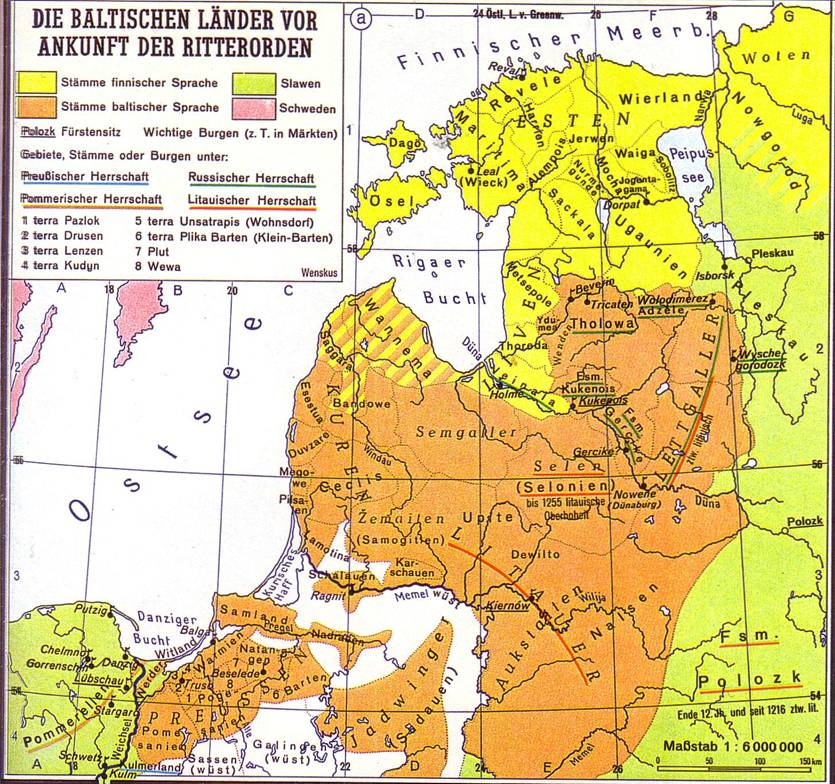
the period of 1300-1100 BC the southern Baltic territory was populated by the
Balts, who inhabited a square area:
GAPS
AND QUESTIONS IN BALTIC PREHISTORY The
preceding information including solid data based on archaeological finds, and
interpretations based on placename evidence and
geological evidence describes at best prehistory in the Baltic. However,
there are gaps in all history, and, likewise, that is the case in prehistory
as well. Burial of corpses occurred only twice during the prehistory of the
Baltic – in the Neolithic era and in the last part of the Bronze Age. Moreoever, some analyses of cultures are based on very
few solid finds archaeologically. Bojtar cites J. Graudonis emphasizing that "we have no anthropological
finds from the territories of Bibliography Balodis, Francis Aleksandrs
Senā Latvija.
In
Latvian. Excellent book about archaeological evidence of prehistoric peoples
in Latvia. Problem: It focuses mainly on Bojtar, Endre. Foreword
to the Past: A Cultural History of the Baltic People. In
English. This book discusses topics related to antiquity in sections:
"How far back does Baltic antiquity reach," "
The first references to Balts," and
discusses tribes in the Baltic as well as underscores the difficulties in
writing about prehistory. It addresses a lot of issues regarding theories of prehistorical significance. Denisova, Raisa. The
most ancient population of Latvia. http://www.vip.lv/hss/denisova.htm.
Viewed: May 14, 2001. Offers
a concise overview of prehistory in Latvia. Dunsdorfs, Edgars. Senie
Stāsti. Melbourne, Austrālijas
Latvietis, 1955. In
Latvian. Pages 7-13 provide some accounts of earlier actual primary sources. Gimbutas, Marija Alseikaite, The prehistory of eastern Europe, In
English. This book has pages of detailed information about the Mesolithic,
Neolithic and Copper age cultures in Krūmiņš, Andrejs.
Mūsu tautas
saknes :
Kultūrvēsturiski pētījumi
. In
Latvian. This book contains a good overview of European and Latvian
prehistory. He often references M. Gimbutiene. Vasks, Andrejs, B. Vaska, R. Grāvere. Latvijas aizvēsture : 8500. g. pr. Kr.--1200. g. pēc Kr. : eksperimentāls
metodisks līdzeklis.
In
Latvian. Interesting, newer edition book with diagrams of archaeological digs
and maps, as well as detailed information. Uustalu, Evald. The
History of Estonian People London, Boreas Pub. Overview
of prehistory in Estonia. Bibliography (Useful sources not cited in paper) 6. Saks, Edgar Aestii: an analysis of an ancient European
civilization In English. Has a few
(10+) pages about Estonian prehistoric peoples. This will be useful to
compare to the books I read in Latvian about the Aestii,
as I will have two sides to this culture, if my paper does indeed stem
towards that idea. 7. Sena
Riga : petijumi pilsetas arheologija un vesture
[redakcijas kolegija Andris Caune (atbildigais redaktores), Ieva Ose, Andris
Celmins Riga : Latvijas
vestures instituta apgads,
1998-2000. DK504.928 .S46 1998 v.1 In Latvian. Compilation
of articles written by archaeologists (Janis Apals,
Ilze Loze. The latter of
the two has a work published on the web, which I noted). This book may prove
useful as pointing out that Riga is representative of nearby cities of about
the same time period, but the book does just focus on one city, and, other
than the first couple articles won’t be much useful. Lithuania : past,
culture, present
[editor, Saulius Zukas ;
authors, E. Aleksandravicius ... et al. ;
translators, Vida Urbonavicius, Jonathan Smith]
Vilnius : Baltos lankos,
c1999 Ilze Loze,
INDO-EUROPEANS IN THE EASTERN BALTIC IN THE VIEW OF AN ARCHAEOLOGIST, http://
http://www.vip.lv/hss/loze.htm
(accessed on April 4, 2001) This site features the
work of Loze, who seems to have summarized rather
well the topic I will be attempting to analyze this quarter: prehistory. Her
work is not cited. This poses a problem. Vasks, Andrejs,
THE CULTURAL AND ETHNIC SITUATION IN LATVIA DURING THE EARLY AND MIDDLE IRON
AGE (1st - 8th Century AD) http://www.vip.lv/hss/vasks.htm
(accessed on April 4, 2001) Vytautas Straižys
and Libertas Klimka
Global Lithuanian Net. Cosmology of the Ancient Balts.
http://www.lithuanian.net/mitai/cosmos/baltai.htm
(accessed April 4, 2001) This site features a good
reference for Baltic prehistory and has itself an enormous reference list. Geraldine Reinhardt, The
Alekseev Manuscript: Chapter VII (continued): Bronze Age in This site contains a
referenced speech given by someone, possibly Reinhardt, as the site contains
numerous links to parts of this speech (?) regarding the neolithic,
mesolithic, paleolithic and
later times in Anonymous (US Dept. of
state), Electronic Research Collection (ERC) web page is an older archived
page from the U.S. Department of State web site, http://dosfan.lib.uic.edu/ERC/bgnotes/eur/estonia94.html
(accessed on April 4, 2001). Site features rough
information about Has interesting
information about sealing, which I may want to use in my paper. Journal of Indo-European
Studies http://www.dla.utexas.edu/depts/lrc/jies/jies_index/authors.html
"Indo-Europeans
between the Baltic and the Claes-Christian Elert,
The Language of southern Scandinavia in the Bronze Age: Fenno-Ugric,
Baltic, Germanic, or ...? http://www.algonet.se/~elert/TheLgSScandinavia_in_BronzeAge.html This is an abstract of a
paper published in Studier i svensk
språkhistoria 4 (utg.
Patrik Åström), 1997, Institutionen för nordiska språk, Stockholms universitet, 106 91
Stockholm. Alludes to language as a source of information in research. Originally
published at http://depts.washington.edu/baltic/papers/
|