|
|
Winter 1990 – 1991: |
||
|
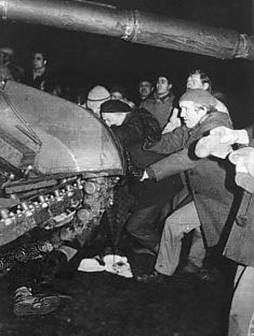
In January 1991, hundreds of thousands of people went onto the
streets of their capital cities to defend their newly declared independence.
The days of the About 700,000 people - nearly a third of the country's
population - gathered in the Latvian capital, after protesters in the
Lithuanian capital, Vilnius, were attacked by Soviet tanks and paratroopers.
The Soviet troops took over the national TV and radio station,
and surrounded the Lithuanian parliament, killing 14 people and injuring more
than 100.
But eventually, the Soviet troops retreated, protesters
triumphed and military rule was not imposed. Both http://news.bbc.co.uk/go/pr/fr/-/2/hi/europe/4609510.stm |
|||
|
|
Lithuania’s
Night of Triumph By Rokas M. Tracevskis, Published: 2001/01/18 |
||
|
In
January 1991, the Soviet army turned their weapons on an unarmed, peaceful
crowd of people who had gathered tightly around buildings of strategic
importance with the intention of protecting them with their own lives. The
10th anniversary of those tragic days was commemorated on Jan 12 and 13 with
speeches and concerts near the national TV and
Moscow
refused to accept the outcome of the vote and attempted to overthrow
Lithuania's government, which by that time controlled the state's political
and economic affairs, apart from the Soviet military bases. On
Jan. 10, Soviet President Mikhail Gorbachev issued an ultimatum to On
Jan. 13, 1991, Soviet tanks and elite Soviet paratroopers brought in from
Audrius Butkevicius, general director of the Lithuanian Defense
Ministry in January 1991 and later defense minister, commented during the
anniversary events that the Mahatma Gandhi-style non-violent defense by the
Lithuanians had proved successful. Most Lithuanians agree that a partisan war
would have started if the Soviets had succeeded in storming Parliament. An
attack on the Parliament would have caused thousands of deaths and it would
have been the end of Soviet president Mikhail Gorbachev's nice guy image. The
West wouldn't have been able to pretend that nothing had happened. "There
was too much meat around Parliament," Vytautas
Landsbergis, leader of the Lithuanian independence movement in January 1991,
quoted an unnamed Soviet officer as saying. The Lithuanian Security Service
was monitoring the radio conversations of Soviet soldiers on Jan. 13, 1991. Gorbachev's
prestige suffered anyway. On Jan. 12, 2001, CNN reports from 10 years ago
about the world's reaction to the massacre in "Gorbachev
is a very, very bad man," a Russian woman told a CNN reporter in broken
English. A placard with the words "Gorbachev = Saddam" was carried
by demonstrators near the Soviet Embassy in "It's
a war. A real war. The Soviet Union against All
these historical images were watched by a crowd of several thousand people
who gathered around bonfires in the square as they had done 10 years before. Norwegian
journalist Hans Steinfeld was in Vilnius in early
January 1991, when Soviet troops were taking one "Two
events blasted away the Steinfeld's roots are in a Jewish traders' family in prewar Liepaja, in
Latvia, but, he said, " Bernadeta Lukoseviciute was a Lithuanian Radio journalist in January
1991. She still works there. "Jan. 13 is like roses of blood in the
Vilnius snow, which is full of tank tracks," Lukoseviciute
said. Parliamentary
Chairman Arturas Paulauskas
was the prosecutor general in January 1991. "Many believed that the
Soviet tanks and paratroopers were just putting on moral pressure. But even
when the Soviets started shooting and the windows of nearby houses shattered
people were not afraid. Many prayed, but nobody left," Paulauskas said. Nerijus Maliukevicius, the director of Lithuanian Radio back in
January 1991, said, "Foreign journalists often ask me about Jan. 13.
It's difficult to explain to them in words. Jan. 13 is in the heart." Landsbergis,
now a Conservative MP, was parliamentary chairman in January 1991. It was the
highest post in the country at the time. He remembers that he asked the women
to leave the Parliament. MPs and Lithuanian volunteer soldiers had already
confessed their sins to a priest and were waiting for the Soviet storm. "The
women refused," Landsbergis said. The MPs urged the people gathered
around the Parliament to leave on Jan. 13 because of the danger, but the
crowd met this appeal by shouting "No!". Landsbergis
called for the extradition of the organizers of the Jan. 13 massacre. He said
during the anniversary, "The Lithuanian-Russian treaty signed by Russian
President Boris Yeltsin in 1992 states that "War
crimes were committed. Special off-center expanding bullets that rip a
victim's body apart were used by the Soviets. These bullets are forbidden by
international convention. This is material for the Hague tribunal. "In
1992, Yeltsin told me, 'We'll extradite them all for you.' But "When
somebody asks me when they'll be extradited I answer, 'When "Our
nation, almost four-million strong, was a single body despite any political
differences. This is why the world supported us. As soon as Feb. 11, 1991,
In a
speech at an anniversary meeting in the Lithuanian Parliament, Grzeskowiak described her feeling of solidarity at the
time. " "This
is a holy night," Bodd said of the
anniversary. "We have to remember the people who sacrificed their lives.
|
|||
|
|
The
Heroic Struggle for Calendar
of Events By Viktors Daugmalis, Originally published at: http://www.barikades.lv/en/3_2.php VIDEO CLIP 1
VIDEO CLIP 2
|
||
1990
November
16 Soviet
President Mikhail Gorbachev issues a series of accusations against the November
17 The
chairman of the Supreme Council of the Republic of Latvia, Anatolijs Gorbunovs, and the
chairman of the Council of Ministers of the Republic of Latvia, Ivars Godmanis, meet with
Mikhail Gorbachev and refuse to sign the Union Treaty. Gorbachev threatens to
institute direct presidential rule and an economic blockade. November
18 There
is a national demonstration in November
19 After
a protest from the November
21 The
Supreme Council of the November
23 The
Soviet Supreme Council gives the president of the November
25 The
Central Committee of the Latvian Communist Party sets up the All-Latvian
Public Rescue Committee, and its delegates announce that they have the right
to sign the Union Treaty. November
26 A
draft of the Union Treaty is published in the Soviet press, along with
statements saying that it can be signed by "authorized
representatives". November
27 Soviet
Defense Minister Dmitriy Yazov
issues an order which says that the armed forces have authority to determine
what kinds of monuments can be set up in the Soviet republics. In a televised
speech, Yazov threatens to eliminate "those
which are ideologically alien". The Latvian People's Front, meanwhile,
launches a petition drive in opposition to the Union Treaty, collecting
1,002,829 signatures by December 17. December
1 The
Central Committee of the Latvian Communist Party launches a radio station
called Sodru? which is
based in the facilities of the December
4 The
All-Latvian Public Rescue Committee demands that recently installed monuments
to Latvian Legionnaires at Code, Vecsaule and D?be dismantled, saying that if
this is not done, it will "take relevant steps". December
5, during the night Four
monuments to the Latvian Legionnaires are blown up. December
6 The
All-Latvian Public Rescue Committee calls for direct presidential rule in December
8 A
total of 27 democratic parties and political organizations sign a declaration
titled "Unified for December
10 The
first secretary of the Central Committee of the Latvian Communist Party, Alfr礳 Rubiks, who is also a
member of the Politburo, says at a meeting of the Soviet Communist Party that
Communist Party General Secretary Mikhail Gorbachev should remind President
Mikhail Gorbachev that the observation of the Soviet constitution and all
Soviet laws must be ensured throughout the Soviet Union. December
11 The
Latvian People's Front issues an announcement of what must be done before
"Zero Hour" (i.e., the institution of presidential rule in December
12 A bomb
explodes at 3:10 AM outside the public policy center of the Latvian Communist
Party at December
13 The
chairman of the Soviet KGB, Vladimir Kryuchkov,
speaks on central television about the indivisibility of the December
14 The Interfront holds its third congress, issuing a call to
the Congress of People's Deputies of the December
17 The
fourth session of the Congress of People's Deputies is opened in December
18 At
2:45 AM, there is an explosion on the grounds of the R garrison's military prosecutor's office
at December
19 Defense
Minister Dmitriy Yazov admits that the Soviet armed
forces have bombed monuments in the December
20 Speaking
at the Congress of People's Deputies, Soviet Foreign Minister Eduard
Shevardnadze warns of the approach of dictatorship and announces his
resignation. December
21 At an
emergency congress, the Baltic Army Association announces that if the
Congress of People's Deputies does not implement order in the Baltic region,
the army will. Behind closed doors, a plan is worked
out on neutralizing At
11:22 PM, there is an explosion at the December
23 Several
dozen people who are part of a secret military unit are discovered at a KGB
hotel in the Latvian town of 1991
January
2 The
OMON forces take over the January
4 In
contrast to claims from OMON officers, Soviet Interior Minister Boris Pugo and Mikhail Gorbachev deny knowledge about the
taking over of the January
7 On
Mikhail Gorbachev's instructions, Dmitriy Yazov
orders special military units to enter January
8 The
Soviet deputy defense minister for emergency situations, Lt. Col. Achalov, arrives in R secretly to meet with Fyodor Kuzmin and Alfr礳 Rubiks.
Achalov has previously been one of the chief
commanders of the Soviet war in January
9 The
White House in the January
10 Mikhail
Gorbachev issues an ultimatum against Lithuania, demanding the repeal of all
recently approved constitutional acts. An unauthorized Interfront
meeting in R calls on the government of Ivars Godmanis to resign. Some 50,000 people attend, and they
try to break into the building of the Council of Ministers when asked to do
so by military personnel. January
11 The
Latvian Women's League stages a protest in R to oppose the drafting of young men from January
12 The
Council of the Latvian Popular Front announces a national demonstration for
January 13 to support the republic's lawfully elected government. The
decision is taken to guard strategically important objects. The presidium of
the Supreme Council of the January
13 During
the evening, tanks encircle the Supreme Council of At
noon, the Supreme Council meets in plenary session to talk about defense
issues. At
2:00 PM, a national demonstration attracts some 700,000 people to the shores
of the Ministers
and Council of Ministers employees set in motion the bringing of heavy
agricultural and construction equipment, as well as trucks full of logs to R so that barricades can be set up. These
orders are implemented during the night and the following day. Barricades are
set up in R, as well as in Liep⪡ and Kuld. The
chairmen of the Russian, Estonian and Latvian Supreme Councils meet in The
chairman of the Supreme Council of the January
14 Speaking
at a meeting of the Supreme Council of the At
2:50 PM, OMON forces attack people who are guarding the Vecmrⶩs bridge.
Members of the forces shoot at the cars of participants, beat up several
people, threaten them with weapons and steal their property. At
6:45 PM, OMON forces attack people at the Brasa
bridge, throwing Molotov cocktails at cars and causing a fire. At
8:00 PM, there is another attack at the Vecmrⶩs bridge.
During the course of the day, 17 automobiles have been burned. The
Svoboda radio station claims several times that there is to be a military
coup in January
15 During
the night, OMON forces twice attack the R branch of the January
16 Funerals
are held in At
4:45 PM, during an attack at the Vecmrⶩs bridge,
Roberts M?ks is shot and
killed, while two other people are injured. At
6:30 PM, OMON forces attack the Brasa bridge,
injuring one person. January
17 The January
18 The
Supreme Council of January
19 The
funeral of Roberts M?ks
turns into a people's demonstration. During the night, OMON forces detain and
beat up five members of a volunteer national guard unit. January
20 Some
100,000 people attend a demonstration in At
9:07 PM, OMON forces and members of other, unknown military units launch an
attack against the Interior Ministry of January
21 The
Supreme Council of January
22 Boris Pugo denies that he ordered the OMON forces to attack the
Interior Ministry. A
participant in the barricades dies. January
24 The
Council of Ministers of January
25 A national
day of mourning. The funeral of the victims of January 20
are held. Most participants at the barricades go home. |
|||
|
|
|||