|
Introduction
The
Soviet Union can be said to have started during the revolutions of 1917:
first in February with the overthrow of the Tsarist regime, and the emergence
of the Provisional Government, which had a largely democratic view toward
government, then in October, when the Bolsheviks, headed by Lenin, Trotsky,
and other educated leaders of the proletariat, took power in the Bloody
Revolution and began the government of Soviet Russia. They by no means had an
immediate acceptance and there was civil war in Russia that lasted until 1920. As
the Red guards (Bolsheviks) and the White armies (anti-Bolsheviks) fought,
the power slowly shifted from the early power of the Whites, to the Red
guards growing ability to organize their troops. During these months, the Red
guard pushed to retain control of Russian lands, including Finnish lands, Estonia, Latvia,
and Lithuania.
At the same time, though, the Germans had hastened war on the Eastern Front
and by the end of 1917, controlled all the Baltic lands.
Having
lost the war to the Germans, the Soviets reluctantly signed The Brest-Litovsk
Peace Treaty on March 3, 1918. Written into the treaty by the Russian
delegation was the premise that all countries which had previously been
deprived of their freedom, would be allowed to seek popular governments of
the people and have their independence. (Tarulis,
p.13)
These
points in the treaty were meant to take the Baltics
and other territories out of German hands, while the Soviets continued to
follow the Marxist principles of independence of peoples. More importantly,
Lenin and others believed that the Baltic lands and Estonia in particular would
choose to join the Soviets after they were free. The German plan to gain
lasting control of the Baltics moved ahead with
early declarations made by a "carefully selected united provincial government,"
which "unanimously passed a resolution asking the Kaiser to Place Estland and
Livland under his personal protection." (Kirby,
p. 263) The emerging Baltic states chose to submit their own Declarations of
Independence; Lithuania in
February 1918, Estonia in
February 1918, and Latvia
in November 1918. (Kirby, p. 263-5) The Germans however, continued to control
the Baltics until the Armistice of November 1918.
When
the General Armistice was signed, the Germans were forced to withdraw their
troops and this left the Baltics open to continued
fighting with the remaining German forces, the Red guards, and other
interested countries. The wars for the occupation or independence of these
countries continued for another couple of years.
In
1920, Soviet Russia concluded peace treaties with the Baltic states: on
February 2, 1920, with Estonia;
on July 12 with Lithuania;
on August 1 with Lithuania,
and finally on October 14, with Finland. This did not end border
issues between these countries, but by the end of 1921, the countries of Finland, Estonia,
Latvia, and Lithuania
were officially recognized by most of western Europe. The relative
independence of the Baltic Nations lasted until 1939, when events leading to
World War II occurred.
The Years of Tribulation:
World War II and Post-War Stalinism
On
August 23, 1939, the Nazis and the Soviets, now under the leadership of
Stalin, signed the Molotov-Ribbentrop
Pact, a non-aggression pact between the Soviets and the Nazis. The Secret
Protocols, which were signed over the next month, divided Eastern Europe
between Germany and the Soviet Union, "in the event of a territorial and
political rearrangement in the areas." (Suziedelis,
p. 92-98) Later in the same year, the Soviets forced the hands of the Baltic
Nations and signed individual Pacts of Defense and Mutual Assistance with
each government. The pacts allowed garrisons of Soviet troops into the Baltic
countries, while they maintained their autonomy. This basic premise of the
pacts was soon abandoned, as war broke out in Europe, with the invasion of Poland by Germany.
The
Soviets issued ultimatums that the Baltic nations set up pro-Soviet
governments and used the presence of the military to force the action. The
Soviets quickly set up People's Governments in each of the Baltic nations. Smetona of Lithuania left soon after the formation of
this new government and was considered to have resigned. Päts
of Estonia
and Ulmanis of Latvia complained about the
situations, retaining their official titles as Presidents of the two
countries, but with little actual power. By July 1940, Päts
and Ulmanis were forced to resign and were deported
to the USSR.
Soviet style elections were set up and all opposition candidates were
required to announce and declare their platforms within approximately three
to four days. Opposition candidates were declared invalid by the election
commissions and communist leaders were elected. (Misiunus/Taagepera, pp. 21-28) The new governments met and passed
resolutions to apply for membership in the USSR. In early August, the
Supreme Soviet met and deliberated on the applications and within five days
had accepted the applications of the governments of Estonia, Latvia,
and Lithuania.
Following
annexation of the countries as republics of the Soviet Union, came the Sovietization of all aspects of life in the Baltics. Appropriation of industry and business affected
the middle class, which was a small percentage of the population.
Collectivization of agriculture affected a far greater percentage of the
population. Larger farms were taken, leaving smaller farms for the original
owners. Much of this land was given in small farm plots to peasants. A few
kolkhozes were established during this early Soviet period.
Bookstores
and presses in the Baltic republics were taken over, which allowed the
Soviets to control the materials that were printed. Churches were allowed to
exist, but the clergy and the churches themselves were highly taxed. Much of
the liturgy and documentation of the churches was destroyed.
Deportations
and executions
began early in the arrests of former political leaders of the Baltic States. The deportations increased in late 1940
and into 1941, before the invasion by the German army. The figures are stated
to be around 85,000 throughout the region. (Misiunus/Taagepera, p. 354)
In
June 1941, the Germans began their invasion of the Baltics
and advanced through most of the region in 17 days. (Misiunus/Taagepera, p46) The heavy deportations that had taken
place in the Baltic republics had weakened the ability of the region's people
to defend themselves. More importantly, the peoples of the Baltic republics
did little to hinder the advance of the German invasion, seen by many as a
way to break away from the Soviet Union and
return to their independence. By the end of August 1941, most of the Soviet
armies had retreated or had been killed. The Baltic region was once again
under German control.
In
1942, Germany
had begun to lose the war, and began a slow, painful retreat. The Soviet
armies again advanced into the Baltic region in 1944. After the fall of Germany's military center in Belarus, the Soviets were able to
advance against the retreating German armies and by October 1944, the Soviet
armies had regained most of the Baltic republics. The deaths during the
German occupation and the reentry of the Soviet armies have been counted to
be close to one million. (Misiunus/Taagepera, p. 354)
Non-native
communists imported from Russia
controlled the Communist Parties of the three Baltic republics. The native
communists were ousted from power and many disappeared during the purges of
the party. The native communists who were allowed powerful positions within
the party were for the most part, those who returned from years in Russia.
These returning leaders were heavily russified and
could be counted on to give support to the government of the Soviet Union. The main resistance to the return of
Soviet power came in the form of the Forest Brothers, who fought a guerilla
war against the Soviet armies. These wars continued until 1953, but were
largely over by 1949 when most of the partisans were infiltrated and
executed.
The
return to collectivization was slow at first, as the land needed to be
restored following the war. As the farms became more productive, the
landowners reluctantly gave up their lands to the kolkhozes (collective
farms). The land that was held by larger farmholders
was taxed heavily, and in 1949, many of the kulaks (wealthy farmholders) were deported. The land was immediately
placed into the kolkhozes and farmed by several families.
The
transplantation of the indigenous peoples of the Baltics
continued through deportation and mandatory service in the army, where many
'undesirables' died. Many people disappeared and were never spoken of again.
Most who were deported were sent to Siberia, or to the labor camps. Here a person's body
could be broken, if not their spirit. The labor camps served as a meeting
ground for people with alternative ideas. This was to play a major role in
later years as the government eased its stance on alternative ideas. This
began with the death of Stalin in 1953.
The Thaw: Nikita
Khrushchev and Post-Stalinism
During
the years that followed the death of Stalin, many changes took place. From 1953-56,
there were temporary leaders of the government and the Communist Party. These
interim years saw a beginning to the break away from the Stalinist form of
government. Most of Stalin's associates were thrown out of their positions of
power. In 1953, Nikita Khrushchev became the first secretary of the Communist
Party and the changes took on an even greater scope. In 1956, at the 29th
All-Union Party Congress, Khrushchev denounced Stalin and the way in which he
handled domestic issues. Khrushchev outlined the issues of Stalin's need to
be the big man in the government and illustrated that the Soviet
Union needed to return to its roots as a government of the
people. Much of what had been forbidden was allowed, within certain bounds:
freedom of speech, but not blatantly anti-Soviet; freedom of cultural
identity, as long as it reflected the greater Soviet identity; and a relative
freedom of movement within the Soviet Union.
Most
of the labor camps were shut down and the people who had been held there were
allowed to return to their homes, as free and rehabilitated citizens of the Soviet Union. These former prisoners found that there
was a new freedom in their homelands. Cultural expression flourished during
most of Khrushchev's period.
The
thaw in the political arena held until 1958, when the climate shifted again.
The government saw that people were pushing issues too far and a purge of the
local communist parties occurred. Leaders in all three countries were moved
out of their positions, but most noticeably in Latvia, where Deputy Chairman Berklavs was removed and most native Latvians were
replaced.
Following
World War II, and the following decades, the tensions between the Soviet Union and the West continued to build. The race
to build and stockpile arms and to gain leads in technological and scientific
breakthroughs moved at a furious pace.
In
1962, Khrushchev was caught in one of the great moments of the cold war. The
Cuban missile crisis defined the strength of two nations and the leaders of
those nations. Nikita Khrushchev followed the pressures of the international
world and of his own government at home, and withdrew the attempted placement
of Soviet nuclear weapons in the hands of communist Cuba.
The
political fallout of the crisis, along with a faltering Soviet economy,
finally led to the removal of Khrushchev from power in 1964. His successor., a leader of the group that ousted him, was
Leonid Brezhnev.
The Years of Stagnation: Brezhnev and the Decline of
the Soviet Union
Leonid
Brezhnev was the first secretary of the communist party from 1964 to his
death in 1982. His leadership can be described as one of continuing the
status quo. The economy of the Soviet Union
continued to decline slowly through all of his years.
The
build-up of nuclear weapons within the Baltic republics continued at a
staggering pace. The eastern bloc of nations was seen as a barrier against
the west and much of the military strength of the Soviet
Union was concentrated in the republics of the west.
The Break-Up: Gorbachev
After
Brezhnev died in 1982, the Soviet Union saw
another transitional government, similar to the period following the death of
Stalin. First to take power was Andropov, who held his position for 18
months. He tried to implement a few changes, many of which were based on
revolutionary ideas. His leadership was hindered by two main factors, the
first being that he was ill during much of his time in power. The second
factor, and probably the more important factor, was that his ideas were just
too much for the conservatives of the Communist Party. Andropov was soon
replaced by Chernenko. His time as the leader of
the Soviet Union lasted for little more than
one year and can be characterized as a time of backtracking on many of the
reforms of Andropov.
In
1985, Mikhail Gorbachev became the leader of the Soviet
Union. His leadership lasted until 1991, when the Soviet Union was disbanded. Soon after taking power,
Gorbachev implemented two major new programs. The first was called Glasnost,
which means openness. The premise of Glasnost was to allow the open
discussion of the Soviet Union by the peoples of the Soviet
Union. This boils down to the idea that citizens could criticize
specific people or policies of the Soviet Union, if it was for the better of
the Soviet Union.
The
second program that he implemented was Perestroika, which means
restructuring. This program was designed to implement changes in the economic
structure of the Soviet Union, a freeing up
the sovereignty of the republics and the people to make new changes to create
a more sound Soviet economy.
These
two programs were meant to strengthen the Soviet Union.
What they lead to was a change in the spirit of the people and the freedoms
which were granted were pushed to test the leniency of the government. This
testing was met with enough openness, that people continued to test and
finally, the opposition movements became so strong, that the government could
no longer hold itself together.
There
was an attempt by some of the former powerful leaders to perform a coup
against the Gorbachev government, but at the same time a new leader emerged
from within Russia,
a man by the name of Boris Yeltsin. He led a popular movement to bring down
the Soviet Union and finally the coup
failed. Gorbachev, working in concert with this new government, created the
mechanism whereby the government of the Soviet Union
could be peacefully dismantled.
Meanwhile,
in the Baltic republics, the people held demonstrations: non-violent marches,
and song festivals that presented only native songs. The parliaments of the
three republics voted for varying degrees of independence from or within the Soviet Union.
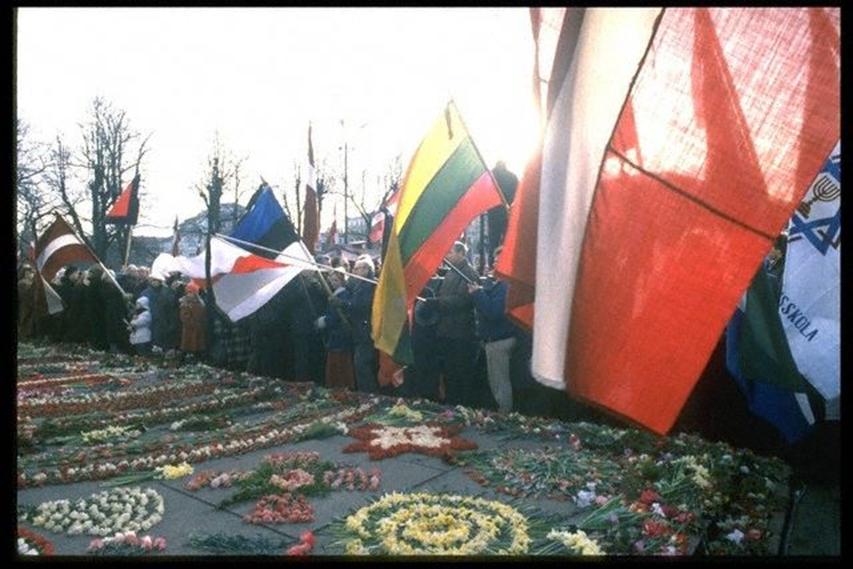
Commemorating the victims of the
soviet rule
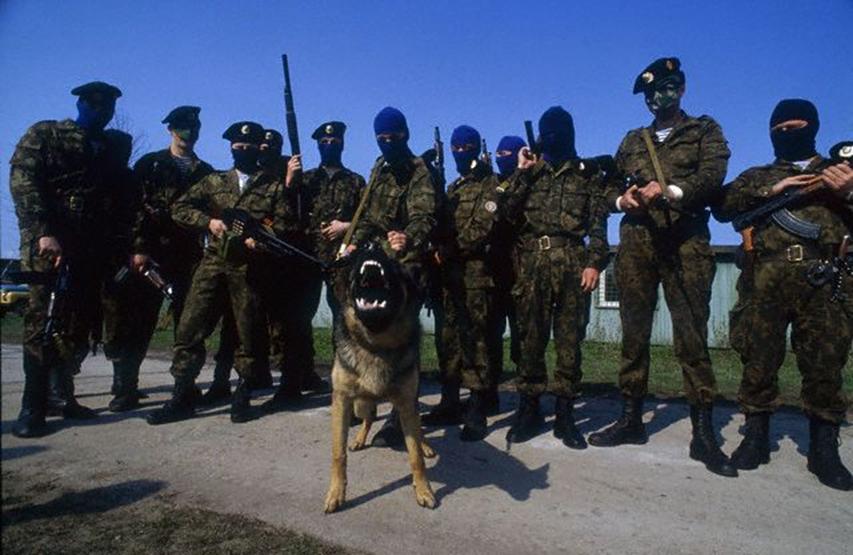
Soviet Special Police Forces
(OMON) created to smash Baltic independence movement
Finally,
I present a poem which states the general feeling of the peoples of the Baltics, a desire for self determination, but a recognition of the fact that few people outside of the Baltics know where, or who they are.
|
Third Elegy
Strange to hail from almost
anonymous shores
in overexplored Europe
where the Baltic
still hides a lunar side, unilluminated
except for subjugations, annexations
which continue unabated for centuries.
Non problem for anyone to name the Nordic countries
from Iceland to Finland,
but how about the Baltic ones?
Surely one and the same language
is spoken here? If not Russian,
at least something akin to German?
You will never guess unless we unravel
the skein of Indo-European and Finno-Ugric
language families, ponder Babel
to clear up the Baltic,
and who has time for such marginal myths?
We persist with the subsoil. Grass is another
favored metaphor (trampled upon, it springs
back),
or limestone cliffs filed away by gales
yet undefiled, withstanding millennia.
It is strange to hail from the dark side of the moon
while supposedly we inhabit the same planet.
There are Third World pockets inside Europe
one tends to overlook, anonymous shores
marked with an x or a mental question mark.
If only you incline in the Baltic direction,
you begin to hear the dirge of a beehive
and perceive in underwater outline
an amber chamber built with pollen of grief.
(Ivask,
p. 11)
|
Video file:

Baltic Way / August 23,
1989
|
Bibliography
Ivar Ivask, The
Baltic Elegies, World Literature Today, 1990
David Kirby, The
Baltic World 1772-1993: Europe's Northern
Periphery in an Age of Change, Longman Group Limited, 1995
Romuald J. Misiunas
and Rein Taagepera, The Baltic States: Years of
Dependence 1940-1990, University
of California Press,
1993
Saulius Suziedelis,
Editor, History and Commemoration in the Baltic: The Nazi-Soviet Pact,
1939-1989, Lithuanian American Community, 1989
Albert N. Tarulis, Soviet Policy Toward the Baltic
States: 1918-1940, University of Notre Dame Press, 1959
Originally
published at http://depts.washington.edu/baltic/papers/
BACK TO THE
BALTIC STATES
|